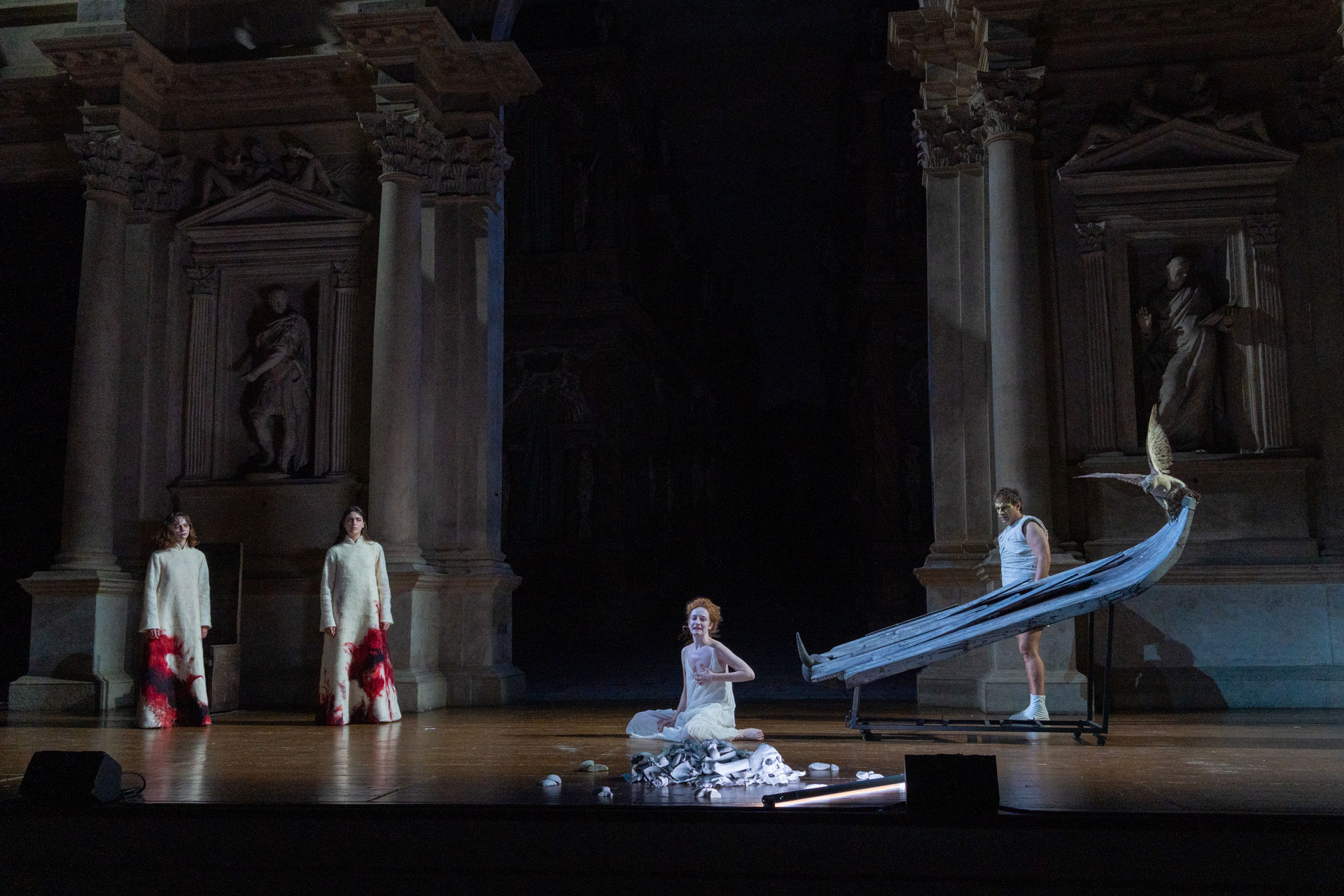


Andrea De Rosa is once again collaborating with playwright Fabrizio Sinisi to bring *Guerra civile* to the stage, a production inspired by Marcus Annaeus Lucanus’s Latin epic poem *Pharsalia* that explores themes and questions that run through the entire history of the West: the relationship between power and violence, the collapse of institutions, and the normalization of war as a political, moral, and symbolic tool.
Civil War
Marco Anneo Lucano / Fabrizio Sinisi / Andrea De Rosa
© Andrea Macchia
Civil War
Marco Anneo Lucano / Fabrizio Sinisi / Andrea De Rosa
© Andrea Macchia
It is 49 B.C. Julius Caesar, at the head of the army that has conquered Gaul, comes to a halt on the banks of the Rubicon, the river that marks the insurmountable boundary between military command and the law of Rome. To cross it means betraying the Republic, choosing war. When he crosses it, the political order collapses in an instant: Caesar wants to seize control of the state. From that irreversible step springs a civil war that has the scale, ferocity, and resonance of a world war: brother against brother, city against city, the law swept aside by force. The war that erupts has the ferocity of a global conflict: from Italy to Mauritania, from Greece to Egypt, it becomes a force that, once set in motion, devours everything in its path. A conflict that rages throughout the Mediterranean, culminating in Pompey’s disastrous defeat at Pharsalus and the transformation of the already faltering Roman Republic into a dictatorship with a single man—Caesar—at the helm.
“Caesar and Pompey,” says De Rosa, “are thus transformed into masks, archetypes of a violence that has marked the history of the West right up to the terrifying conflicts that bloodied twentieth-century Europe. Lucan’s poetic language meets a contemporary theatrical language—lyrical yet violent—that seeks to speak directly to our time.”
Partner di produzione

Sponsor stagione prosa