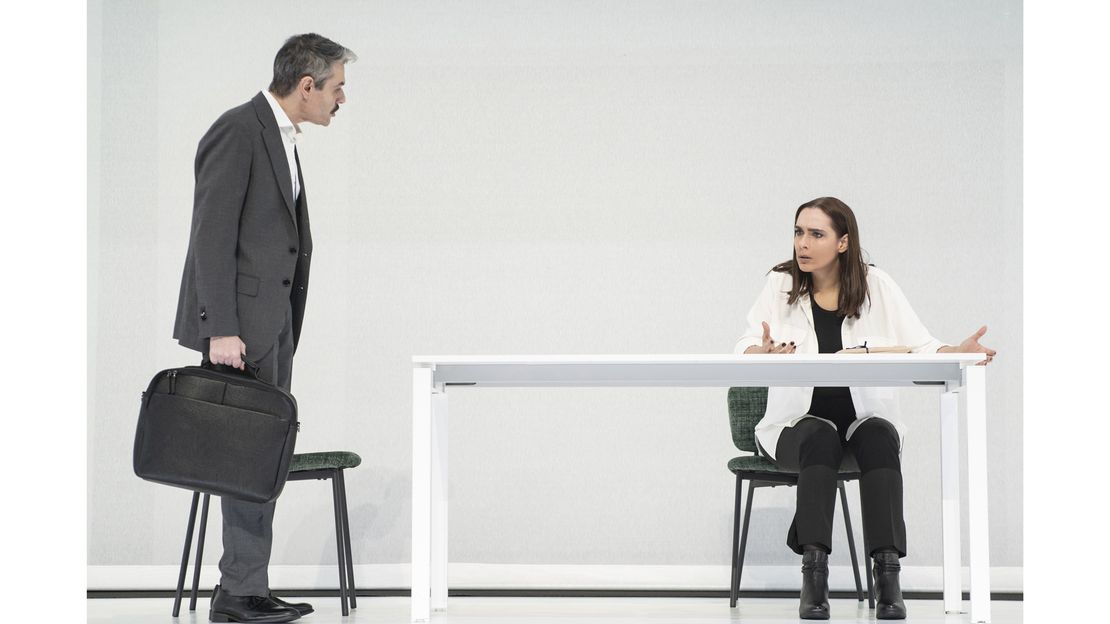
For his first direction at LAC, Jacopo Gassmann chooses to measure himself against The City by Martin Crimp, one of the most important and radical British authors on the contemporary dramaturgical scene. A black comedy, disturbing and enigmatic, balanced between fiction and reality, between memories and memoirs.
Set in what might appear to be a normal bourgeois interior, the play opens on a real couple's crisis whose protagonists are Chris, an employee of a large IT company who has learned that his division is preparing for a ‘reorganisation’ of its staff, and his wife Clair, a translator who has just had a fortuitous and ambiguous encounter with a writer called Mohamed, who, after revealing to her that he has been tortured, gives her a diary intended for the daughter from whom he has been cruelly separated. She is joined by her neighbour Jenny, a nurse married to a doctor engaged in a secret war abroad, who complains that Chris and Clair's screaming children disturb her daytime sleep.
The tension between husband and wife is evident; no one seems able to listen. Imperceptibly, picture after picture, their relationship - like the text itself - begins to show its first cracks: the boundaries between realism and fiction are blurred, the characters seem almost to disappear in their dialogue.
‘Influenced by Beckett, Pinter and Mamet, Crimp's theatre,’ says Gassmann, "is characterised by an underlying restlessness and cruelty, often diluted by a grotesque and surreal vein.
The City is one of his most representative plays: a black, restless, Kafkaesque comedy, centred on the power of language. [...] What began as a simple domestic tension turns inexorably into a two-man delirium, through which the threats of the outside world creep in: a world where one can be fired out of the blue and where wars, seemingly distant, can suddenly burst in on us, inside us, like nightmares in broad daylight."
Jacopo Gassmann, scrolling through your CV we cannot fail to notice your predilection and great interest in British dramaturgy: where does it come from?
My interest in British dramaturgy, particularly contemporary dramaturgy, originated in the early days and is partly linked to my personal, biographical path: I attended English and American schools, studying first in New York and then in London. The Anglo-Saxon countries have a different tradition to ours: if you go to the theatre in London, the main name on the playbill is that of the author, whereas the history of Italian theatre, although studded with famous playwrights, was written more by the great directors, who took classical texts and decomposed, fragmented and revisited them. The British tradition, in a way, puts the author first, and this creates a whole series of consequences: British theatres, but also American ones, have - something I love very much - drama departments that are buildings in their own right, parallel and communicating with the theatres. In Italy - and this is a personal battle of mine, I always say it - we need more attention to contemporary dramaturgy, we need contemporary dramaturgy departments in the great permanent theatres. Then there is also a question of taste and “transference” with respect to certain authors I particularly love, but the discourse would be interminable. Certainly, Crimp is one of the interesting ones.
In addition to British dramaturgy, we note that you have already tackled the direction of no less than three texts by the Spanish playwright Juan Mayorga; your work on The Boy from the Last Stand was received with particular interest and won you an award. Can you tell us about these experiences?
Juan Mayorga, who over time has become a kind of older brother, has been a true master for my theatrical research. Mayorga's theatre is the theatre that interests me, made up of texts that are somehow open, that are multipliers of questions; I do not like plays that tell me how things should be. Mayorga is a philosopher, a mathematician; he addresses a critical spectator by asking him to complete within himself what he has seen. The “great theatre” is that which is reconstructed in the memory and which stirs something within us, allowing us to answer the questions that a text, a performance has suggested to us.
My first work by Mayorga was in England. Then I debuted in Italy [at the Teatro Belli in Rome in 2013, ed] with La pace perpetua - a very strange, Kafkaesque text, with four characters who are talking dogs, philosopher/ neo-Kantian dogs - and then this very beautiful experience at the Piccolo in Milan [in 2019, ed] with Il ragazzo dell'ultimo banco, in which the story between a professor and a particularly gifted pupil turns into a sort of generational battle, but it is also a great game of Chinese boxes of quotations from great literature.
In short, I can say that they were extraordinary and formative experiences.
For your first LAC production, you chose to work on a text by Martin Crimp. Tell us about the reasons that led you to choose this author and, specifically, the play The City?
The City is a text I have known for a long time, which I read when it was written - it debuted in 2008 - and which immediately struck me.
I really love the theatre of Crimp, an author considered to be Pinter's heir, because it is non-naturalistic theatre, unlike so much English theatre. Crimp goes against a certain British tradition of naturalism. His is a theatre that I would call “post-apocalyptic”, which comes after the explosion and fragmentation of the word, of language; he puts back together the ashes of language itself, and in this sense, he is a bit of Pinter's heir, but also Beckett's. He is an anomalous author, among the English ones, and he is also a very harsh author, in some ways enigmatic, who asks many questions without resolving them, leaving it to the director and the actors to do so.
The City is a formidable text, different from Crimp's more experimental works such as Attempts on Her Life, his best known and most experimental text. I found The City particularly intriguing because it plays at a faux naturalism: the text, all things considered, has its own narrative plot, but within the story there are multiple fractures, there are Crimp's typical stylistic features. It is interesting because it is a “softer” Crimp, a softer Crimp, which allows one to follow a story. It is a fascinating story that, as in the great texts, is composed of several levels. On the one hand, we have the relationship of a couple that is going through a crisis; we experience this sort of crumbling, crumbling of their relationship as the text progresses. At the same time, however, we follow the story of a translator who also tries to be a writer; if you like, the whole text can be read as a series of attempts by the protagonist, Clair, to write drafts.
It is a text that unravels like an enigma, a mystery. The title, The City, evokes all those non-places in contemporary metropolises: right from the start, two great contemporary non-places are mentioned, a station and a company that is reorganising its staff, places that seem to have been built to alienate us from ourselves. The “City” is also a great metaphor for the protagonist's inner city, but I don't want to tell too much.
There is also the very topical theme, experienced by Chris, the other protagonist, of unemployment or the risk of losing one's job in this world of flexible jobs (Crimp, in fact, takes Richard Sennett's book The Flexible Man as a model).
Crimp is indeed a cerebral author, but The City is also a profoundly poignant and emotional text: all the characters, at a certain point, seem to collapse in on themselves, faced with the impossibility of moving forward in a world that is becoming increasingly complex and cumbersome; they evaporate within their attempts to exist, to give themselves an identity through words.
The Italian version of The City has been translated by Alessandra Serra, who has worked for years as the official translator and spokesperson for an author who has marked the history of European theatre such as Harold Pinter.
In the past, you have often translated theatre texts from English into Italian: can you tell us about the relationship between translation work and directing?
Actually, I have dedicated a lot of time to translation: in almost all the other experiences I have had theatrically, I try to translate the texts myself - obviously in the languages that are accessible to me - because for a director it is essential to make the words that you then go on to work on stage your own.
The job of theatrical translation is a special job because you have to have a certain ear for the stage. Translating is a complex job, it is a bit like rewriting - here one can open huge debates, whether certain translations that respect the text more or others that betray it but, paradoxically, respect it more.
Certainly, that of a translator is a job that I love very much. And it is interesting that one of the great themes of The City is precisely this and that the protagonist is a translator.
The captions in the script show us bare settings and the protagonists dressed in casual clothes. Did you respect these indications in your staging? How?
For this production you relied on Gregorio Zurla for the sets and costumes: can you tell us about it?
Crimp likes to pose difficulties not only for the directors, actors and set designers who tackle his works, but also for the spectators, as the very bare captions themselves are enigmas and often indicate things contrary to what the protagonists then say in their lines (for example, during a conversation, Chris and Jenny talk about how beautiful the lawn of the garden they are in is, and Crimp writes in brackets “there is no lawn”).
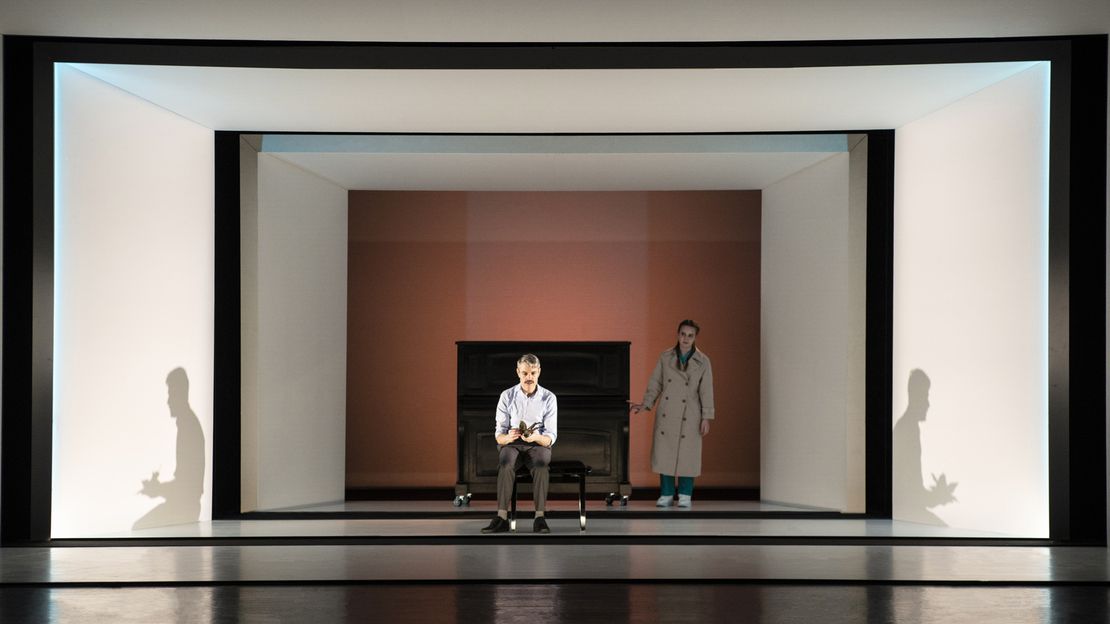
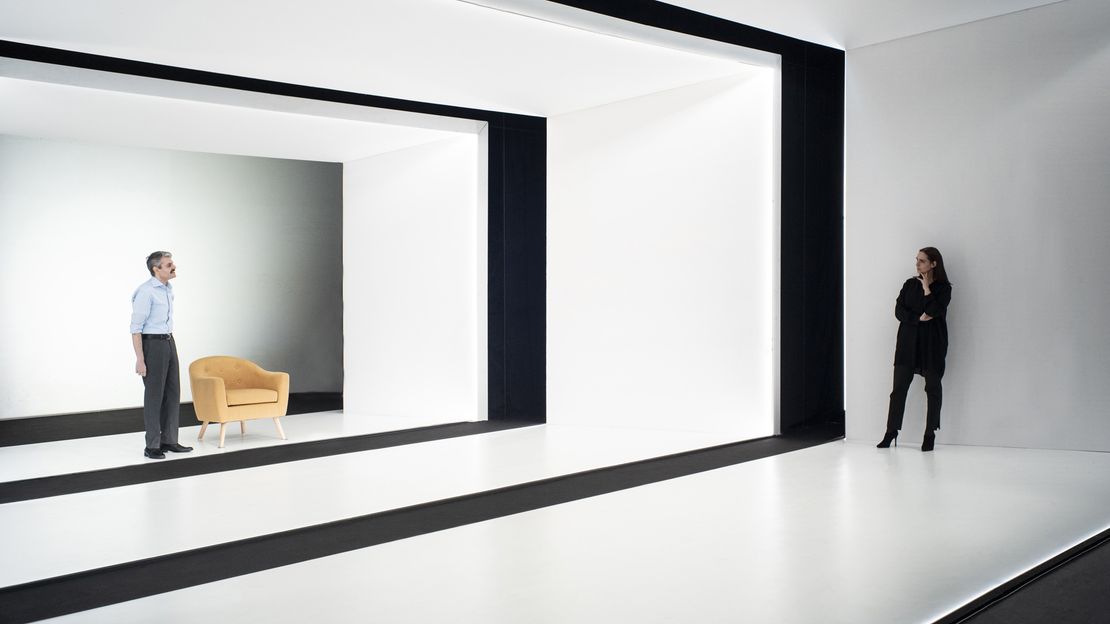
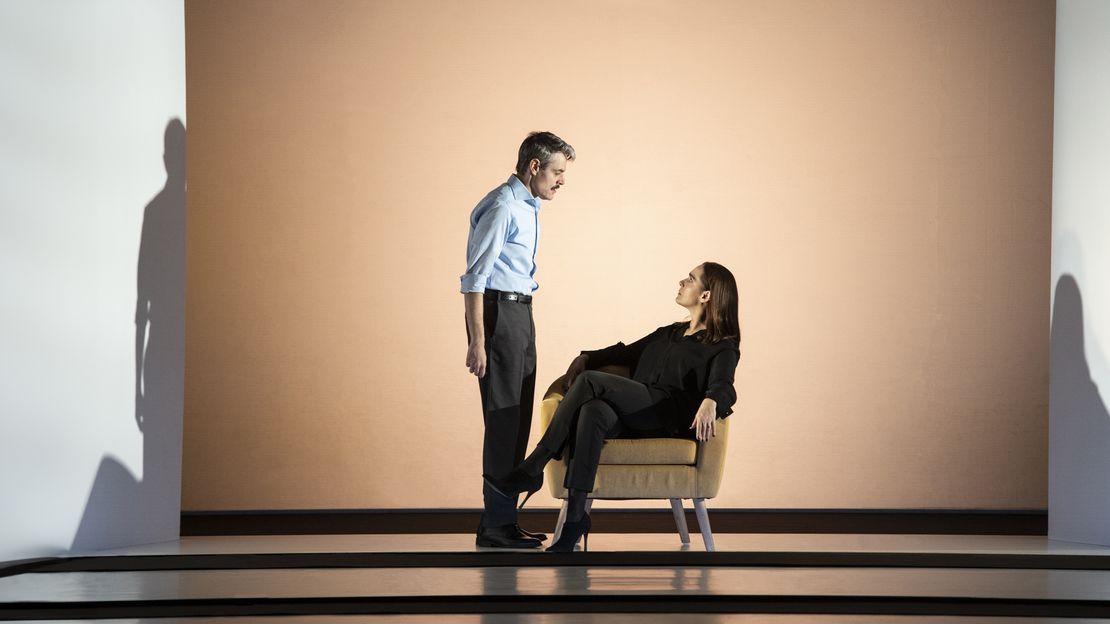
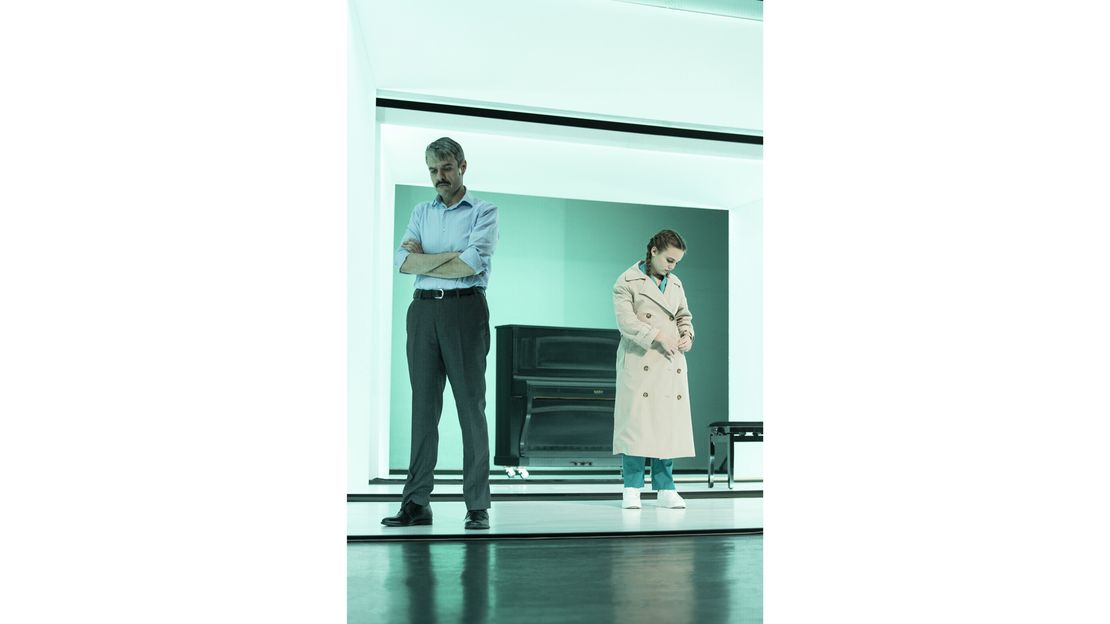
Paradoxically, Crimp actually leaves a great deal of freedom of action. The City is a text that can take a directorial vision down many possible paths, many possible paths, playing on this very thin line between reality and fiction. What seemed interesting to me was trying to work on an environment that was not completely bare and empty - it seemed too much - but that was partly concrete, partly plausibly a house or a portion of a house. As in a dream process, we only dwell on unique elements, like an armchair, but then the whole living room is missing. I thought this was an interesting way of proceeding with respect to this text, which is indeed very dreamlike and hallucinatory.
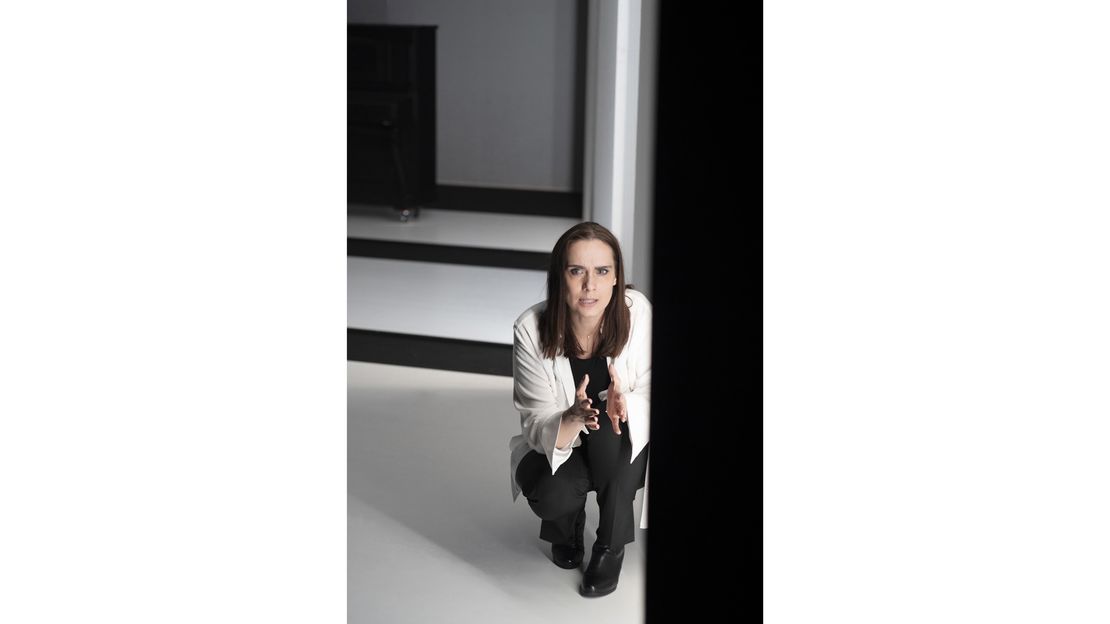
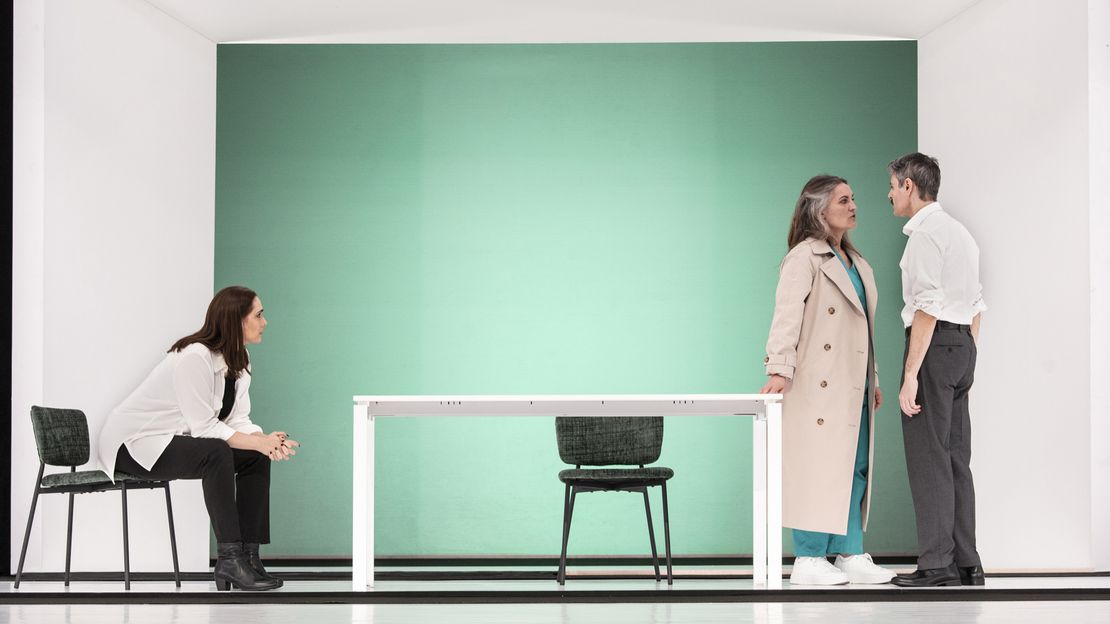
Picking up on the theme of these non-places in large contemporary cities, which are alienating places, seemingly made to make life easier for us but which in reality close us off (even from ourselves), our set design was conceived as a multi-layered environment, manageable in such a way that at certain moments it seems to close the protagonists themselves inside claustrophobic places or in any case that it allows the characters to be separated from each other.
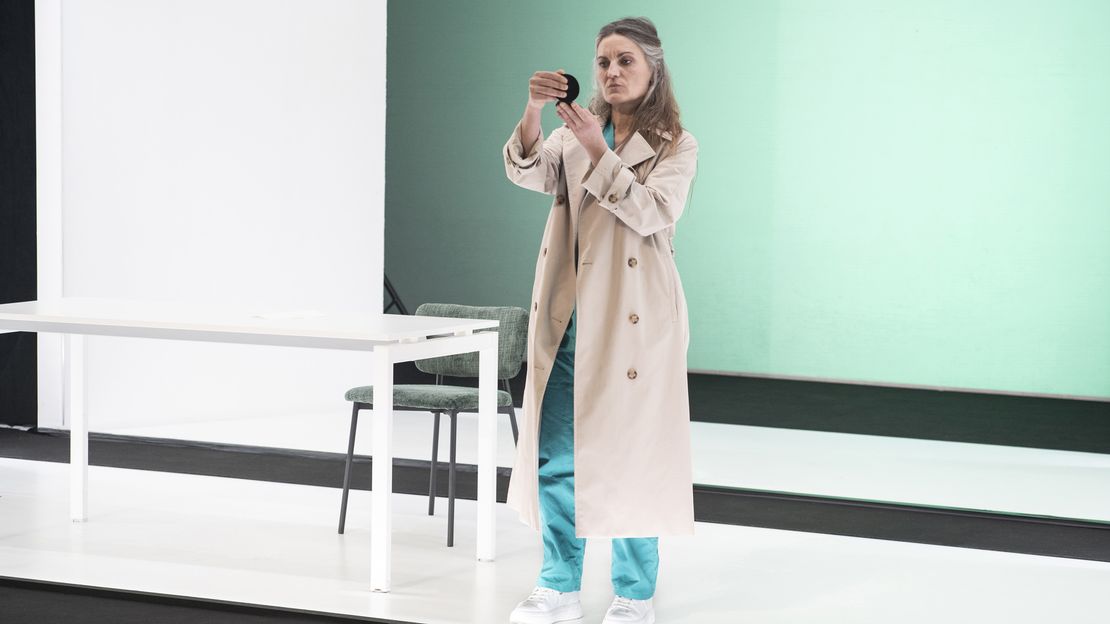
As for the costumes, Crimp gives fairly precise indications. For our part, we made a series of reflections, including that of imagining the performance in a sort of imaginary line parallel to the protagonist's creative process, thus starting with few colours, almost black and white, and slowly adding small patches of colour and new elements.
For this LAC debut, you are relying on the talent of young, versatile actors...
Yes, absolutely, we are working with a cast of very good and willing actors: they are Lucrezia Guidone, Christian La Rosa, Olga Rossi and the very young Lea Lucioli.
It is first and foremost a cast of talents, regardless of age: together we are exploring a complex text that often leads, during rehearsals, to blind alleys and to having to contradict choices that seemed certain. The fact - this yes - of working with young actors helps because, in some way, they make themselves available for an exploration “without a net”, they are also willing to fall in with you and start again. And this is what you have to do with a text of this kind: you cannot tackle Crimp's The City with all the certainties on the first day; you have to enter the labyrinth and hope, at some point, to come out safe and sound.
Notes on translation
by Alessandra Serra
In an interview about The City, Martin Crimp says: "One of my favourite images to represent humanity is that of the city, which I used, for example, in the play The City, a place where each writer and each artist creates his or her own imaginary world, which they gradually explore; or a labyrinth, into which they penetrate with their torch and a spool of thread so as not to get lost, peering into the many openings, where sometimes they find gold or sometimes a monster. Everyone uses their imagination to make discoveries, but at the same time we must not forget that there are also rules to follow. Writers and artists set their own rules and work within those rules'.
In The City, we also find Crimp's typical restlessness, as well as menace, psychological violence, bullying, anaffectivity and much more.
One can feel the influence of Harold Pinter (1930-2008, Nobel Prize for Literature in 2005), who held Crimp in high esteem, as did the Scotsman David Harrower (1966), especially in the timing, rhythm, spoken and unspoken lines, subtexts, pauses and “full” silences. On the other hand, Pinter revolutionised all theatrical conventions, and anyone who wants to write for the theatre today must take this into account otherwise they risk becoming obsolete even before they go on stage.
Notes on sets and costumes
by Gregorio Zurla
A blank space like a blank page to be filled. Or rather, several pages in succession, organised in an anomalous perspective tending towards infinity.
A neutral space, designed so that the smallest visual sign can emerge clearly and powerfully.
There are no doors or windows, just a sequence of identical rooms, where objects and situations are multiplied, separated only by white walls that can dissolve into transparency.
Characters and objects appear like notes on a sheet of paper. Excerpts of thought, sometimes unfinished and subject to rethinking, to small imperceptible transformations. Like the regrets of a painter (in this case a writer) who tries to correct himself in the process, in an attempt to focus on an idea, a thought.
And just as the perspective of this space tends towards infinity, the achievement of this last thought seems elusive.
Notes on the lighting project
by Gianni Staropoli
In the growing parabola of the creative process with Jacopo, there is always a wealth of dialogue and artistic exchange. From the very first reading, from the first coffee, we delve into the text, the internal themes, the atmospheres, the backgrounds, the colours, the characters, and everything that emerges and basically leads us to imagine light and space. The dialogue between collaborators - in concentric circles - is very lively and active. With Gregorio and Jacopo it is always a beautiful creative journey, and for me designing light becomes a construction of meaning that goes beyond the dramaturgy of light.
That of The City is a light inside the space, indirect: you see it (read it) if you see the space; it is there but it is not. The characters, within this scenic space, are not illuminated by traditional lighting fixtures, pointed and positioned precisely to highlight or underline something. The actors somehow experience space and light at the same time, as a single level and vision, a visual level that is perhaps lighter, distant, diaphanous.
The spectators, thanks to the author of the text, to all our staging work and, above all, to their imagination, will go beyond the drawn wall.
Notes on sound design
by Zeno Gabaglio
Point and line
No, the title above refers neither to graphic design nor to morse code, but is intended to recall and emphasise the dual nature - point and line - that characterises the approach to sound design for The City.
From the outset, Jacopo Gassmann had very clear ideas about the musical cues and sound he wanted to bring into dialogue with the scenic, textual and acting elements. Thus an essential starting point was the sound material of authors such as Alva Noto, Ryoji Ikeda and Ryūichi Sakamoto (with the cameo of an unsuspected Christmas Johnny Cash), to which original field recording elements were added to evoke ambient noises, realistic but not too much.
The reference to dot and line, however, tells of the functions that sound plays in the show. On the one hand - through the dot - we work on a narrative level, with short or very short interventions to evoke concrete presences (objects, natural) that with their appearance and disappearance signify precise events, inside and outside the characters.
Line, on the other hand, refers to those sound bands with a broad temporal dimension that do not have to narrate something happening, but must suggest a context. In stage music (but also in film soundtracks), soundbands are generally associated with an emotional level, with feelings to be conveyed. The work done with Jacopo for The City, however, has been very careful not to condition - or worse still, not to force - the emotional scope of the music and thus of the scenes. The sound line, here, is above all an epoché: a suspension that suggests that in addition to the semantic plane of the sensitive there may be others. Confirmed or denied by the evolution of the performance itself.
Notes on movements
by Sarah Silvagni
I was lucky enough to be present from the very first rehearsals in the auditorium, thanks to the sensitivity of Jacopo Gassmann, an attentive and indefatigable director, who allowed me to witness the fascinating and frightening moment in which the word takes shape.
Mine is an invisible work of observation and collection that places itself in borderline territory, in search of the rhythm between space, body and time.
We delved into the dark matter of Martin Crimp's The City, my travelling companions and I, in search of those recurring signs that could allow the definition of a bodily punctuation to free its meanings.
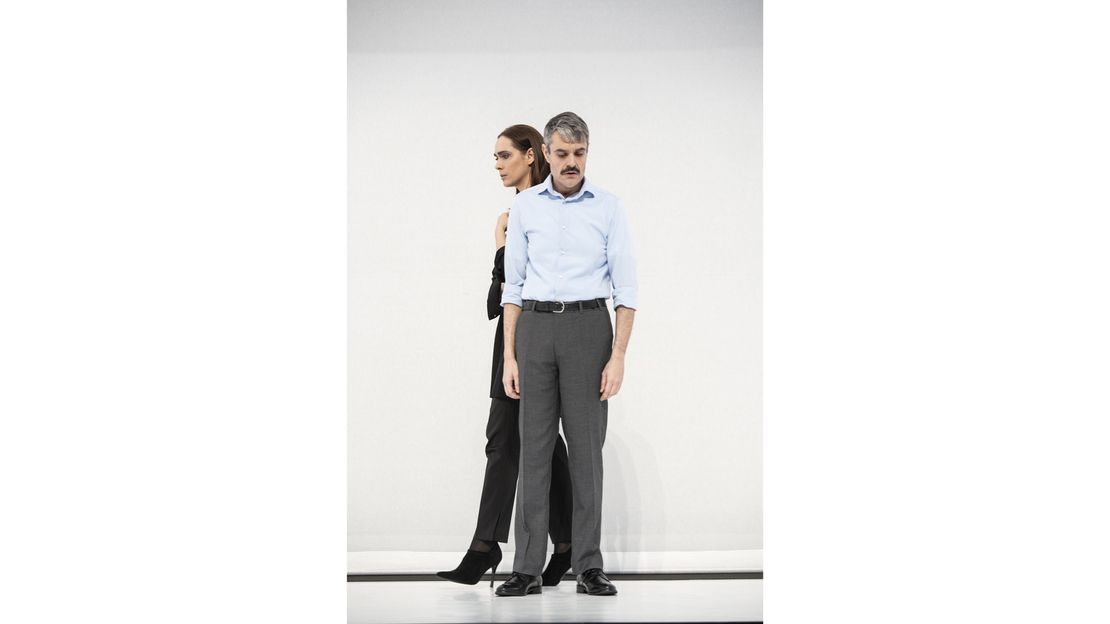
We find ourselves in a scenic environment governed by the principle of distance, everyone is enclosed in their own sphere, in their own internal space, the few moments of intimacy, of shared glances between Chris and Clair are found only at the beginning, in the flow of an apparent family routine.
It begins with logos, the word that at first seems to create a bridge between the two, but which soon sanctions in an even more overbearing manner the denial of any possibility of encounter.
Everyday gestures begin to reveal the first cracks, gradually, picture after picture, the distance increases, we proceed by interruptions, stumbles and fragmented paths in which the bodies remain imprisoned and isolated in closed spaces between imperceptible membranes.
The characters move along trajectories that chase each other, proceeding in hiccups through attempts at contact destined to fail in an incapacity for closeness and intimacy. The bodies seem suspended in a non-place in which proximity is paradoxical and in which the rare moments of vitality are extinguished in the contraction of compressed emotions.
As they move through the spaces, we see them reproduce the same patterns and the same code like a broken record, the actions become increasingly absurd and meaningless, the characters begin to empty themselves, to move in an awkward, “rigid and colourless” manner, and the danger of the outside creeps in like a cold draft between the frames of a poorly closed window.
by
Martin Crimp
translation
Alessandra Serra
direction
Jacopo Gassmann
with (in alphabetical order)
Lucrezia Guidone
Christian La Rosa
Olga Rossi
and with, for the first time on stage
Lea Lucioli
sets and costumes
Gregorio Zurla
lights
Gianni Staropoli
sound design
Zeno Gabaglio
movements
Sarah Silvagni
video
Simone Pizzi
assistant director
Stefano Cordella
stage director and chief stagehand
Ruben Leporoni
chief electrician and light giver
Fabio Bozzetta
sound engineer
Alberto Irrera
production and stage tailor
Lucia Menegazzo
scenes realised by
FM Scenography
led system realised by
Best Light srl
production
LAC Lugano Art and Culture,
Teatro Stabile del Veneto - National Theatre
Elfo Theatre,
Emilia Romagna Teatro ERT / Teatro Nazionale,
TPE - Teatro Piemonte Europa
Martin Crimp
Polish-born British playwright and theatre translator, was born in Dartford, Kent, in 1956. He is the son of John Crimp, a railway engineer, and his wife Jennie. In 1978, he graduated in English Literature from St Catharine's College, Cambridge, where his first play, Clang, inspired by Beckett and Ionesco, was published. Before establishing himself as a playwright, he devoted himself to fiction, composing a collection of short stories, An Anatomy, and a novel, Still Early Days, both of which remain unpublished. In 1980 he began working at the Orange Tree Theatre in Richmond, where his first six plays were staged. After a stint as a scriptwriter for Thames TV, he began working with the Royal Court Theatre in London in 1990, becoming resident author in 1997. Nine of his plays - including Attempts on Her Life (1997), his best-known and most innovative text, translated into twenty languages, and The City (2008) - and his translation of Ionesco's The Rhinoceros (2007) were staged at this London theatre, known for its contribution to the development of modern dramaturgy. He quickly established himself as an emerging playwright of the new British theatre scene, coming to influence authors such as Sarah Kane. Since the mid-1990s, his reputation has been growing not only in Great Britain but also abroad, especially in Europe: today he is considered one of the most interesting British playwrights and is often called the Harold Pinter of the 21st century. He has some 20 plays to his credit, almost all of which have been translated and performed in London and throughout Europe.
His plays offer a critical view of the moral and social decline of postmodern society, outline current themes such as the contemporary individual's bewilderment and loss of identity, and investigate the relationship between reality and fiction. Stylistically, they are characterised by the use of dry dialogues, an emotional detachment and a gloomy look at human relationships. The language adopted, closely linked to reality, seeks to trace poetry in a courtly and rhetorical lexicon, resorting to the sharp weapon of irony that characterises a certain English dramaturgy, such as that of Becketti and Pinteri.
Alessandra Serra
Translation
Born in Rome, she lived and completed her studies abroad. Back in Italy, in Milan, in 1974, she began to collaborate with various publishing houses, and in 1979, together with Tullio Riva, she founded Serra e Riva Editori, which mainly publishes minor works by major writers. In 1983, he sold the publishing house to Mondadori, which continued to publish under the same logo but with a different editorial policy. Since 1985, she has devoted herself entirely to the theatre and the translation of plays from English, French and American. In 1989, she became the official translator and spokesperson for Harold Pinter.
She also translates works by Arnold Wesker, Ronald Harwood, Martin Crimp, David Hare, Tom Stoppard, Don DeLillo, Ariel Dorfman, Eugène Ionesco, Hanif Kureishi, Yasmina Reza, John Osborne, Graham Greene, Greenaway and others. Many of his translations are published in Einaudi's “Collezione di teatro” series. He has written short plays for radio, an adaptation of Anton Čechov's Reparto 6 and Edgar Allan Poe's The Philosophy of Composition, both of which have been performed in Italy.
Jacopo Gassmann
Director
Born in Rome in 1980, he graduated in Film Directing from New York University and obtained a Masters in Theatre Directing from the Royal Academy of Dramatic Art in London. While in the United States, he attended theatre and film directing courses at various universities and made several works, including About the house (selected in the Cineasti del presente competition at the 2004 Locarno Film Festival). He is the author of documentaries, including La voce a te dovuta, presented at various international festivals, and Il più bel gioco del mondo. In 2005, he curated and signed the stage direction of Il minore ovvero preferirei di no on the life and work of Ennio Flaiano. In the following years, he is responsible for the artistic selections of the International Festival of Palazzo Venezia and the Sole e Luna Doc Fest. He translates and adapts numerous theatrical texts from English into Italian and collaborates as a teacher with the Experimental Directing Centre in Milan. Between 2010 and 2012 he lived in London, where he directed Juan Mayorga's Nocturnal and worked in the Drama Department of the Soho Theatre. In 2013 he directed Mayorga's Perpetual Peace; in 2015 he inaugurated the Trend New Frontiers of the British Scene, translating and directing Chris Thorpe's Confirmation; in 2016 he translated Mike Bartlett's Bull and translated and directed Thorpe's There has possibly been an incident . In 2017 he translated and directed Ayad Akhtar's Disgraced , a finalist for best director at the Le Maschere del Teatro Prize and as best new foreign text at the Ubu Awards. The project The Theatre of Chris Thorpe wins the 2018 Franco Enriquez National Prize for Best Direction and Translation. In the 2018/19 season, he translates David Greig's Yellow Moon and Bartlett's An Intervention . In 2019 he directs Mayorga's Il ragazzo dell'ultimo banco for the Piccolo Teatro di Milano, a finalist for the Hystrio Prize as best play of the season and winner of the Flaiano International Prize for direction. In 2020 he stages Niente di me by Arne Lygre at the Venice Theatre Biennale; in the same year he wins the National Association of Theatre Critics award for directing. In 2022 he directed Iphigenia in Tauride at the Greek Theatre in Syracuse; in the 2023/24 season he directed Giuseppe Verdi's Macbeth . He is editor of the contemporary theatre series Green room (Luca Sossella editore).
Lucrezia Guidone
Clair
After graduating from the Silvio D'Amico National Academy of Dramatic Art in Rome, she moved to New York where she continued her training at the Lee Strasberg Theatre and Film Institute. In theatre, she works with big names on the Italian and international scene, debuting with Luca Ronconi in In Search of an Author by Luigi Pirandello in the role of the stepdaughter, which earned her the Ubu Prize. In 2013 she was on stage at the Piccolo Teatro in Milan with Panico by Rafael Spregelburd and in 2014 with Celestina by Michel Garneau, again directed by Ronconi. Federico Tiezzi directed her in Pier Paolo Pasolini's Calderón , Arthur Schnitzler's La signorina Else and Sophocles' Antigone , for whose role of Antigone she won the Le Maschere del Teatro Italiano award as best actress. At the Teatro Stabile di Torino she played Jelena in Uncle Vanja by Anton Chekhov directed by Kriszta Szekely. She also received the Virginia Reiter Prize and the Duse Prize for her theatrical career. With the Teatro Stabile d'Abruzzo, she signed her first theatre direction, staging Donatella Di Pietrantonio's novel L'Arminuta, also as the absolute protagonist. She is the founder and artistic director of The Lab, the film section of the Point Zero acting school based in Rome. In cinema, she participates in successful Italian and international productions: she wins the Flaiano Award as best actress for Noi 4 by Francesco Bruni; she stars in La ragazza nella nebbia by Donato Carrisi. In 2017 she won La Repubblica's ‘Giovani Talenti’ award at the Festival dei due Mondi in Spoleto and the Best Leading Actress award at the Melbourne Film Festival for Time Zone Inn. On television she takes part in the Sky series Where's Mario and the Netflix series Luna Nera, Summertime and Fidelity. In 2023 she is on stage with Mario Martone's Romeo and Juliet and joins the cast of the Rai series Mare Fuori 4. In cinema she will star in the film Eravamo bambini by Marco Martani, recently presented at Alice nella città.
Christian La Rosa
Christopher
From Piedmont, he graduated in 2012 from the School for Actors of the Teatro Stabile di Torino. In the same year, he took part in the international theatre workshop directed by Luca Ronconi at the Venice Biennale. In theatre, he works with, among others, Carmelo Rifici, Valter Malosti, Massimo Sgorbani, Andrea Chiodi and Liv Ferracchiati. In 2016 he took part in the staging of Holy Ecstasy. Atridi: otto ritratti di famiglia, directed by Antonio Latella, and in the project Qualcuno che tace, from three texts by Natalia Ginzburg, directed by Leonardo Lidi. In 2017, he was Pinocchio in Antonio Latella's play of the same name, an interpretation that earned him the Ubu Award as best actor under 35 and the ANCT Award. In 2018 he is in the cast of Spettri directed by Leonardo Lidi, winner of the Bando Registi under 30 of the Venice Biennale. The collaboration with Lidi will continue in the following years with Gabriele D'Annunzio's La città morta, August Strindberg's La signorina Giulia, Molière's Il misantropo and Anton Chekhov's Il gabbiano . He returns to work with Latella in the 2019/20 season, in The Valley of Eden, from John Steinbeck's novel. His most recent theatre engagements include Macbeth, le cose nascoste and La pulce nell'orecchio by Carmelo Rifici, Animali domestici by Antonio Mingarelli and Dramma industriale by Giovanni Ortoleva. He alternates his activity as an actor with that of a voice actor. He acted in the film Una questione privata by Paolo and Vittorio Taviani and in the RAI television dramas C'era una volta Studio Uno and Non uccidere 2.
Olga Rossi
Jenny
Born and lives in Tuscany. She attended the School for Actors of the Teatro Stabile of Turin, where she graduated in 2000 under the direction of Mauro Avogadro. Subsequently, she joined the Turin Theatre's Youth Company, engaged in the three Shakespearean productions of Much Noise for Nothing, Romeo and Juliet, A Midsummer Night's Dream. In theatre he worked, among others, with Massimo Castri, Giancarlo Cobelli and with Carmelo Rifici in La signorina Julie by August Strindberg and in L'officina by Angela Dematté. In 2004 she was part of the first advanced training course for actors at the Centro Teatrale Santacristina directed by Luca Ronconi, who later directed her at the Festival Dei Due Mondi in Spoleto in the play Lezioni. She collaborated, again in theatre, with Alessandro Gassman, Francesco Bolo Rossini and Alessandro Genovesi. In cinema she works with Gabriele Salvatores, Rocco Papaleo, Giuseppe Loconsole, and participates in several TV series, including Vita da Carlo with Carlo Verdone, I delitti del Barlume, È arrivata la felicità and the Netflix series La legge di Lidia Pöet, directed by Matteo Rovere.
Lea Lucioli
Little girl
She was born in a small village in the Val D'Orcia, where she still lives. The theatre, the dressing rooms, the streets, the towns are the places of her childhood, part of her mother's life and, inevitably, of her own.
She participates in theatrical initiatives in her town, following M. Massari's courses, where theatre is first and foremost a game made up of stories, small rituals, timeless ancestral magic that, a little at a time, can still enlighten and ignite passions.
Due to a more or less fortuitous series of encounters and intersections that inevitably animate the life of each of us, after an audition in Rome she was chosen by Jacopo Gassmann. The City is her theatrical debut.
Gregorio Zurla
Sets and costumes
Graduated from the Brera Academy of Fine Arts, in his early years he worked as assistant set designer in the main Italian opera houses, including Opera di Roma, La Fenice in Venice, Comunale in Bologna, Maggio Fiorentino, Sferisterio in Macerata. Subsequently, he embarked on a career as a set and costume designer, collaborating with numerous important directors for whom he designed sets and costumes in both drama and opera; among them, Jacopo Gassmann(Iphigenia in Tauride), Federico Tiezzi(Calderón, Antigone, Faust, Purgatorio, Antichi maestri, La signorina Else, L'apparenza inganna, Il soccombente), Valter Malosti(Il giardino dei ciliegi, Il misantropo), Cecilia Ligorio(L'italiana in Algeri, La Cenerentola by Gioachino Rossini), Virgilio Sieni(Metamorphosis), Marco Lorenzi(Otello, Come gli uccelli, Kamikaze), Stefano Simone Pintor(Il flauto magico, Ettore Majorana, Falcone, Alfredo il Grande), Filippo Dini(Agosto a Osage County), Silvio Peroni(Molto rumore per nulla), Claudio Autelli(Demoni by Fabrizio Sinisi, based on Dostoevsky).
He was nominated as best set designer at the Ubu Awards for Calderón and at the Le Maschere del Teatro Italiano Award for Antigone. In 2011, with director Pintor, he won second prize at the European Opera-directing Prize, while in 2017, again with Pintor, he won the European Opera Oggi Competition.
In the fashion sector, he collaborated with Zegna designing the 2015/16 and 2016/17 Couture fashion shows. Future projects include Macbeth by Jacopo Gassmann, Fedra by Federico Tiezzi, Don Giovanni by Cecilia Ligorio, the contemporary opera Dorian Gray by Stefano Simone Pintor, and Romeo and Juliet by Filippo Dini.
Gianni Staropoli
Lights
He began his professional activity in 1997 collaborating with the poet, author, director and actor Marcello Sambati, founder of the Dark Camera company, a leading group in the Roman avant-garde of the 1970s. In 2006 he embarked on a path of study, thought and research of light and stage space as coessential and constitutive elements of the new contemporary theatre language. She currently collaborates with various directors and choreographers for Italian and international productions, and leads masterclasses and workshops for universities and performing arts professionals on the use of light in the space of contemporary theatre and on the dramaturgy of light. In 2020 he participates in the international study conference Lumière Matière at the Giorgio Cini Foundation in Venice. In 2021 he publishes two articles: for La Falena, magazine of theatre criticism and culture published by Teatro Metastasio in Prato, and for Lumière Matière (University of Lille and University of Padua). In 2022 he stars in the documentary film La parte maledetta. Viaggio ai confini del Teatro, a project by Teatro Akropolis. He is a tutor at the Anghiari Dance Hub training project directed by Gerarda Ventura. He is a tutor at Téchne, a residency, training and technical research project on light at Lavanderia a Vapore in Collegno (Turin). He is a project lecturer at the Accademia Nazionale d'Arte Drammatica Silvio d'Amico in Rome. In 2017 and 2019 he received the Ubu Award for best lighting design for the shows Il cielo non è un fondale and Quasi niente by Deflorian/Tagliarini. In 2022 he was a finalist in the Ivo Chiesa - I Mestieri del Teatro Award.
Zeno Gabaglio
Sound Design
After obtaining a diploma in cello, a Master's degree in free improvisation and a degree in philosophy (in Lugano, Basel and Florence), he dedicates himself to music in various forms, preferring the most authentic and - perhaps - least obvious approaches. To date, he has released five records(Uno, Pulver&Asche 2007; Gadamer, Altrisuoni 2009; Niton, Pulver&Asche 2013; Tiresias, Pulver&Asche 2015; Cemento, Shameless Records 2021), created more than forty soundtracks (for film or theatre) and participated in concerts in Europe, America and Asia. With the trio Niton, he was recently included in the collection Interactions: A Guide to Swiss Underground Experimental Music and, over the past year, has created the soundtracks for the films Lassù by Bartolomeo Pampaloni (Jury Prize at the Trento Film Festival), Supertempo by Daniel Kemény, Arzo 1943 by Ruben Rossello, Ultime luci rosse by Villi Hermann and Hugo in Argentina by Stefano Knuchel. In the theatrical field, he collaborated with Carmelo Rifici for La pulce nell'orecchio, Ulisse Artico, Lingua Madre. Capsule per il futuro, Macbeth, le cose nascoste, Uomini e no, Iphigenia, liberata, Purgatorio e Gabbiano; with Andrea Chiodi for Sogno di una notte di mezza estate and La bisbetica domata; with Trickster-p for Eutopia, Book is a Book and Nettles; with Antonio Ballerio for Non ogni notte la luna. He is also President of the Music Subcommission of the Canton Ticino and Vice-President of the Fondation SUISA.
Sarah Silvagni
Movements
An expert in Choreographic Pedagogy with decades of experience, she has worked as a dancer and performer in Italy and abroad. In recent years she has dedicated herself particularly to the facilitation of creative processes, working alongside directors and authors in the care of movement scores during the construction and artistic research phases, both in the live performance and audiovisual spheres. The need to develop critical thinking with regard to methodologies and transmission of body languages led her to deepen her study of somatic learning processes, graduating as a teacher of the Feldenkrais Method in 2011 and obtaining the first level in Laban Bartenieff Movement System analysis in 2021. For over ten years she has been teaching Movement and coordinating the Acting course at the Gian Maria Volonté School of Cinematographic Art in Rome, collaborating with institutional educational realities such as the University of Roma Tre (Master Pedagogy of Expression), the Silvio d'Amico Academy of Dramatic Art and the University of Turin. He curates participatory dance events in public space and DanceAbility workshops involving professionals and non-professionals with different abilities, striving to make choreographic fruition and production as accessible and inclusive as possible. In her many years in close contact with young performers, she has increasingly developed an awareness of the theme of consent and limitation that has led her to complete the Safe Sets in Intimacy Coordination training at Anica Academy; she is currently in training to complete the SAG AFTRA certification.
Simone Pizzi
Video
She began her Cinema studies at the Catholic University of Milan where she graduated in Media Languages, completing a Master in Digital Cinema and Television Production. In 2013 he graduated in Film Direction at the Civica Scuola di Cinema ‘Luchino Visconti’ in Milan; his first short film entitled Sweet memory will die participated in Italian and international festivals.
In 2016, he founded the film production company Habanero Film with which he made his subsequent documentaries: La strada per Canaan (The road to Canaan ) and Come te stesso (Like yourself) deal with the theme of encounters between foreigners and Italians within the context of religious denominations. His subsequent works deal with the theme of the pandemic: Homeland from a health point of view, L'onda lunga from a social and economic one.
His latest documentary, Stories of Rebels for Love, tells the Italian Resistance from the fascinating story of Don Giovanni Barbareschi (1922-2018). He alternates his work as a documentary filmmaker with directing video clips, commercials and corporate videos.
Stefano Cordella
Assistant director
Director, author, psychologist and theatre trainer. After graduating in Psychology, in 2009 he graduated from the Accademia dei Filodrammatici in Milan. He is one of the co-founders of Oyes, a theatre company of which he was artistic director until 2022, taking care of the conception and direction of several shows and winning the 2018 Hystrio Iceberg Prize. In recent years he has often collaborated with the Teatro Stabile del Veneto for which he has produced the shows R+G, Amleto - Tutto ciò che vive, Quando tutto questo finirà. Since 2019 he has been among the teachers at the Carlo Goldoni Academy. He won the Fantasio Theatre Directing Festival from which he created Lo soffia il cielo (from texts by Massimo Sgorbani), a Trentospettacoli production for which he also directed H - Il campione del mondo (7 rounds with Ernest Hemingway), and participated in the projects Teatro Giornale by Roberto Cavosi and Spoon River by Angela Dematté.
Since 2018, he has been co-artistic director of Hors, a festival for young emerging companies at Teatro Litta in Milan, for which he also directs the shows Decameron - Una storia vera, La rivolta dei brutti and is currently working on Dostoevsky's The White Nights.
He has been assistant director to Carmelo Rifici(Il compromesso), Ferdinando Bruni and Francesco Frongia(L'ignorante e il folle, La tempesta), Bruno Fornasari(Sospetti). He trained, among others, with Declan Donnellan at the Biennale Teatro in Venice. Since 2013, he has been artistic co-director of the Nova Milanese Theatre.
LAC Lugano Arte e Cultura
20-21.02.2024
Teatro Verdi, Padova
28.02.2024–03.03.2024
Teatro Goldoni, Venezia
07-10.03.2024
Arena del Sole, Bologna
14-17.03.2024
Teatro Astra, Torino
19-21.03.2024
Teatro Morlacchi, Perugia
23-24.03.2024
Teatro Elfo Puccini, Milano
02-07.04.2024
Stage photos