Sorry we didn't die at sea

Emanuele Aldrovandi / Mirko D’Urso
Teatro Foce

Past event

04 April 2025

20:30

05 April 2025

20:30

06 April 2025

18:00

Sorry we didn't die at sea

Emanuele Aldrovandi / Mirko D’Urso

Teatro Foce

Past event

04 April 2025

20:30

05 April 2025

20:30

06 April 2025

18:00

A finalist for the Riccione Prize and the 2015 Scenario Prize, following several translations and productions abroad—most recently its debut at the Park Theater in London in 2023 – *Scusate se non siamo morti in mare* returns to the stage in Italian, directed here by the playwright himself, Emanuele Aldrovandi.

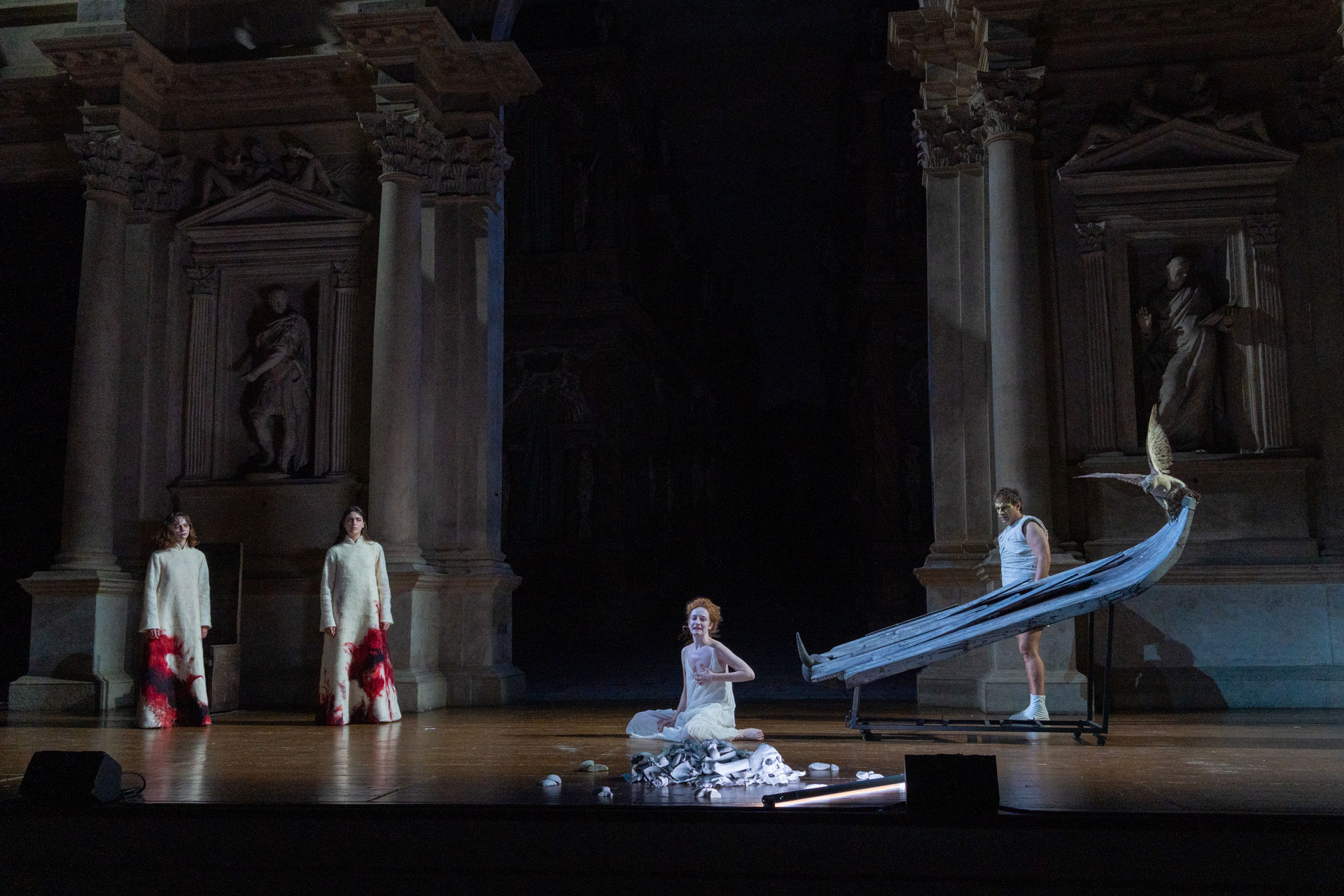
A journey that is both a mirage and a nightmare. A crossroads where hope is lost and regained. In a future very close to our own, the worsening economic crisis has transformed Europe into a land of emigration. Three “emigrants” and a smuggler find themselves shipwrecked in the middle of the sea, aboard a shipping container. The journey will be grueling: hunger, thirst, the sea, fear, death…
The play is by the award-winning playwright and director from Emilia, Emanuele Aldrovandi, who has previously been a guest at the LAC with *Isabel Green*, *Farfalle**The Extinction of the Human Race*, as well as the author of the adaptation for the production *La bottega del caffè*, and features Mirko D’Urso, artistic director of the Compagnia MAT, on stage.

written and directed by

Emanuele Aldrovandi

with

Mirko D’Urso, Tomas Leardini, Luca Mammoli, Sara Manzoni 

scenes

Francesco Fassone

costumes

Costanza Maramotti

movement and choreography

Olimpia Fortuni

production

MAT Company

in co-production with

LAC Lugano Art and Culture, Theater Association of Living Playwrights

Staging your own play ten years after writing it is, in a sense, a bit like working on another author’s play. A stranger with whom one shares a few biographical details and a few memories.
The desire to do this came to me because, in recent years, I’ve seen many plays that have addressed the theme of immigration and recounted the massacres in the Mediterranean— some of them very effective and moving—but all based on a reality in which we Italians/Europeans/Westerners are trapped in the dichotomy of “border-builders” versus “rescuers.”
*Sorry, We Didn’t Die at Sea* starts from an opposite premise; it isn’t realistic, it doesn’t take a “direct” political approach, and it doesn’t strike emotional chords tied to the present. To all intents and purposes, I’d say it’s about something else—another kind of emigration, other dynamics, and another theme—which I believe has more to do with the relationship between the passage of time and the image we manage to form of ourselves, as social beings, within this continuous natural change.
As a director, I therefore chose to push this departure from reality even further, toward the surreal and the archetypal, using the rotating set design to emphasize the passage of time and dividing the stage action into oblique cinematic shots, in which the audience should be led to feel unbalanced—not only visually but also in terms of their social and moral judgment of what they see.
I therefore believe that the challenge of balancing realistic acting within a symbolic stage setting—a feature that links this production to the latest works I have staged—also takes on a meta-historical significance on this occasion.
