Casanova

Fabrizio Sinisi / Fabio Condemi / Sandro Lombardi

Sala Teatro

Past event

11 March 2025

20:30

12 March 2025

20:30

World premiere

25.03.2025

LAC Lugano Arte e Cultura

Tournée

19–24.05.2026

Teatro Elfo Puccini, Milano

13–17.05.2026

Teatro Vascello, Roma

07–10.05.2026

Teatro Storchi, Modena

28.04.2026

Teatro Asioli, Correggio (RE)

03–06.04.2025

Teatro Rossini, Pesaro

27–30.03.2025

Teatro Bonci, Cesena

18–23.03.2025

Teatro Astra, Torino

Casanova

Fabrizio Sinisi / Fabio Condemi / Sandro Lombardi

Sala Teatro

Past event

11 March 2025

20:30

12 March 2025

20:30

World premiere

25.03.2025

LAC Lugano Arte e Cultura

Tournée

19–24.05.2026

Teatro Elfo Puccini, Milano

13–17.05.2026

Teatro Vascello, Roma

07–10.05.2026

Teatro Storchi, Modena

28.04.2026

Teatro Asioli, Correggio (RE)

03–06.04.2025

Teatro Rossini, Pesaro

27–30.03.2025

Teatro Bonci, Cesena

18–23.03.2025

Teatro Astra, Torino

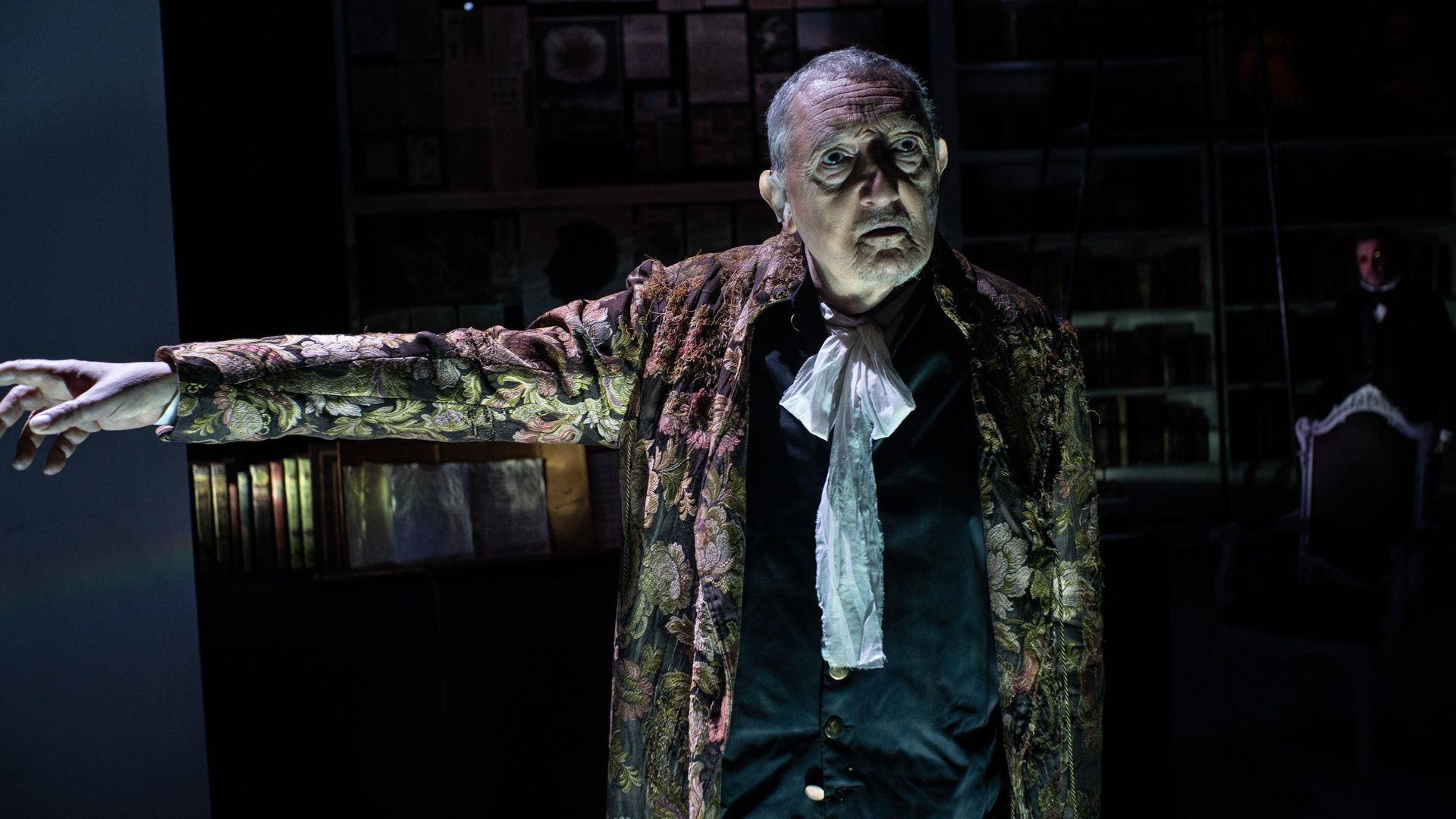
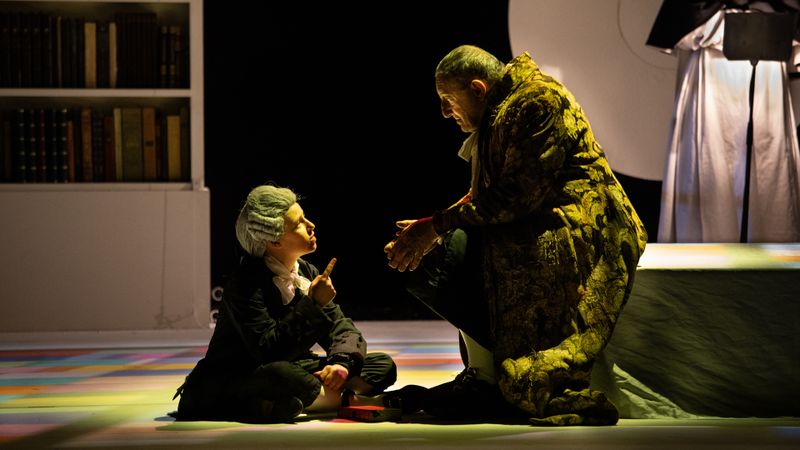
After taking on Pier Paolo Pasolini in *Calderón* and Thomas Ligotti in *Nottuari*, director Fabio Condemi returns to collaborate with the LAC, staging *Casanova*—a production for which Fabio Cherstich is responsible for set design and visual dramaturgy, based on an original text by Fabrizio Sinisi. Inspired by the autobiographical memoirs of the famous Venetian intellectual Giacomo Casanova, the production features Sandro Lombardi, a leading figure in the Italian theater scene.

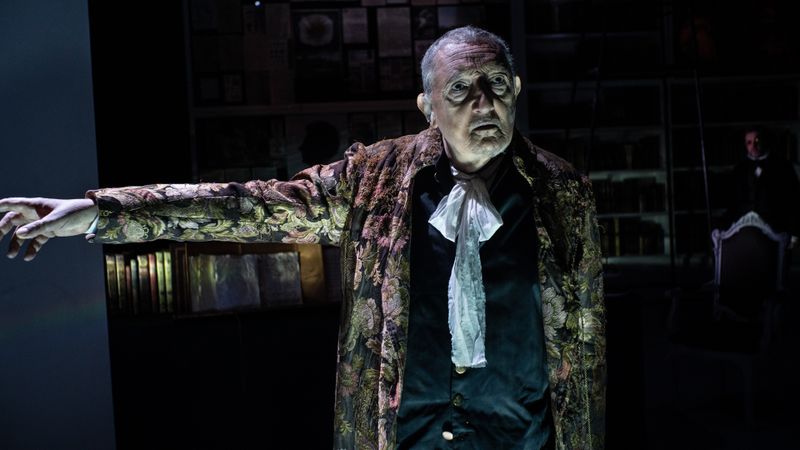
Winter 1798. At Dux Castle in Bohemia, a physician skilled in mesmerism is summoned to examine a man now in the twilight of his life: Giacomo Casanova, who has served as librarian to the Count of Waldstein for fifteen years, wishes to recover his lost memory. Worn down and embittered, Casanova spends his days among old books and clashes with courtiers who speak to him in a language foreign to him. 
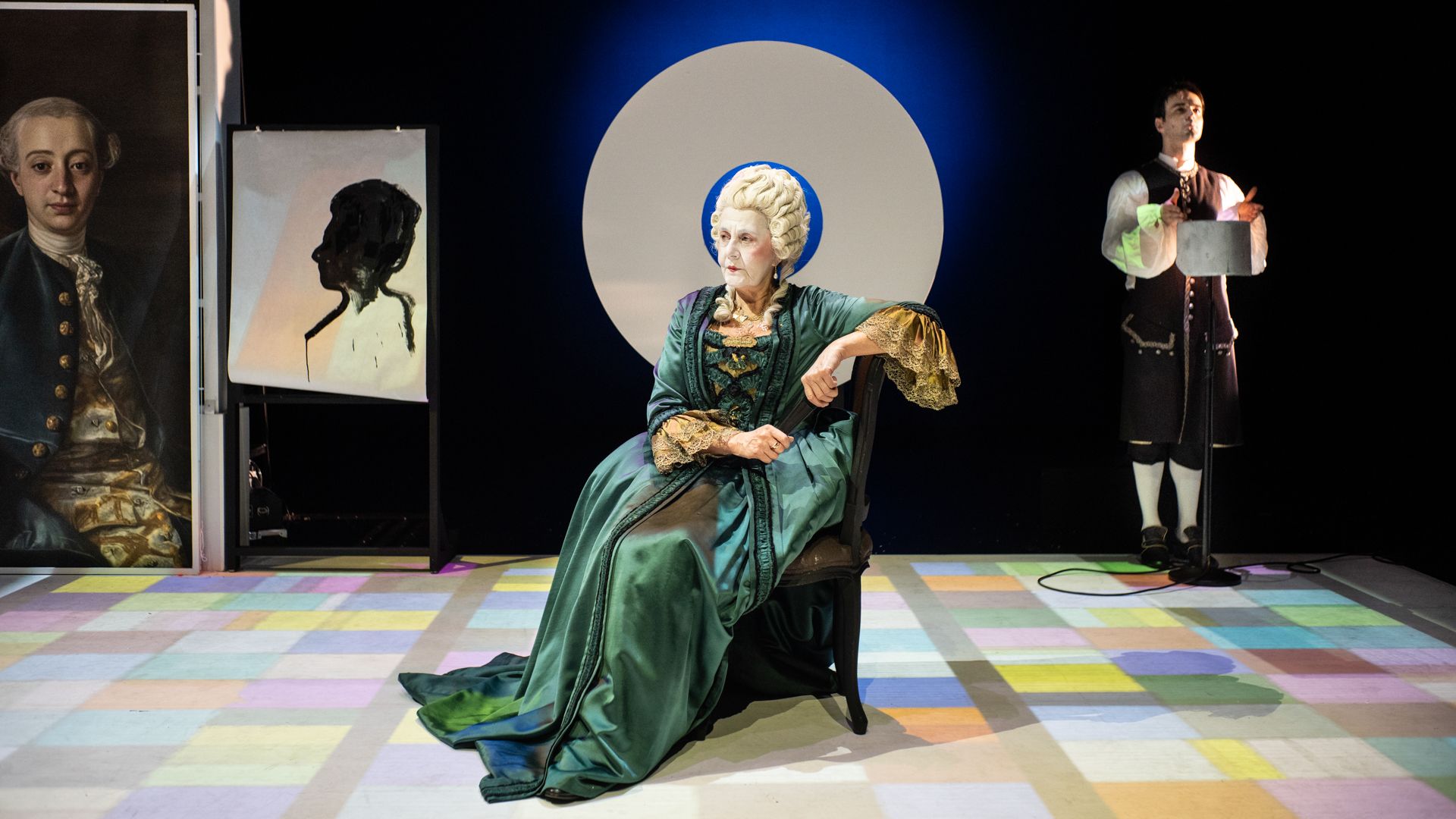
During the mesmeric session, the altered state of consciousness throws open the doors to Casanova’s memory, but the memories that surface are not those described in his *Mémoires* : they are visions, premonitions, and apparitions. The doctor listens to Casanova’s story—a tale populated by ghosts, a journey in which figures from his past appear, such as Friar Balbi, his young lover Henriette, and the enigmatic Marquise d’Urfé. But is memory really what Casanova is seeking? Or perhaps, having reached the end of his journey, the only true relief is oblivion?
*Casanova* is a reflection on memory and on the passage of time across an entire era. Philosopher, magician, and con artist, Giacomo Casanova lived through the Age of Enlightenment before passing away at the end of the 18th century, as the world was transforming and the modern era was beginning.

by

Fabrizio Sinisi

loosely based on 

The Story of My Life by Giacomo Casanova

directed by

Fabio Condemi 

with

Sandro Lombardi

and featuring (in alphabetical order)

Marco Cavalcoli, Simona De Leo, Alberto Marcello, Betti Pedrazzi

on stage for the first time

Child actor TBD

Scenes and Dramaturgy of the Image

Fabio Cherstich 

costumes

Gianluca Sbicca 

lighting design

Giulia Pastore 

Music and Sound Design

Andrea Gianessi

assistant director

Andrea Lucchetta

set design assistant

Andrea Colombo

costume design assistant

Eleonora Terzi

stage manager and chief stagehand

Stefano Orsini  

Chief Electrician and Lighting Designer

Filip Marocchi

sound engineer

Andrea Trona   

prop master

Benedetta Monetti

costume designer

Lucia Menegazzo

company administrator 

Laura Favero-Franzos  

scenes filmed at  

ERT Set Design Workshop  

costumes  

Farani Theater Costume Design  

footwear  

Pedrazzoli Footwear 

wigs  

Audello Theater  

production

LAC Lugano Art and Culture

in co-production with

Emilia Romagna Teatro ERT / Teatro Nazionale
TPE - Teatro Piemonte Europa
Lombardi–Tiezzi
Company Teatro Vascello 

Characters and Cast

Casanova 

Sandro Lombardi 

Mesmerist

Marco Cavalcoli 

Henriette

Simona De Leo 

Voltaire

Alberto Marcello

Marchesa D’Urfé

Betti Pedrazzi 

Casanova as a Child

Edoardo Matteo 

Ghosts, Memory, the Enlightenment 

Winter 1798: A doctor specializing in mesmerism arrives in Dux, Bohemia, to visit the elderly librarian. That librarian is Giacomo Casanova, who has been in the service of the Count of Waldstein for fifteen years. Casanova appears old and worn out. He is cataloging books and is angry with the courtiers of Dux who speak to him in German, a language he does not know. The only endeavor that still fascinates him is the writing of *Histoire de ma vie*, the massive memoir of his life, his adventures, his travels, and his escapes. Having reached the seventh volume, Casanova has begun to lose his memory and, terrified, has summoned the mesmerist to help him recover it. The elderly Casanova—an eternal exile and stranger in the New World, a relic of the past—is obsessed with lost time and his lost childhood, and he recalls those moments to relive them with his whole being. During the mesmeric session, Casanova, in an altered state of consciousness, begins to remember; but these are not true memories—they differ from those he described in his memoirs and take the form of visions, premonitions, and apparitions. The doctor listens to Casanova’s story, a story populated by ghosts and phantom images. For Casanova, the memory begins with an episode of epistaxis—a child with blood flowing profusely from his nose. After the memory—or daydream—of the nosebleed, Casanova finds himself in the darkness of a monastery: the white bed illuminated by moonlight, the voices of the priests, their demands upon him, and his bonds with his fellow monks. Casanova, now deeply immersed in a mesmeric sleep, finds himself at a Venetian banquet during his last night of freedom. In fact, on the night between July 25 and 26, 1755, he was arrested and imprisoned in the Piombi. The official charge was that he had circulated anti-religious verses. The Mesmerist doctor who tries to heal him—or wake him up—is mistaken in the dream for his cellmate, the Somascan friar Marino Balbi. On the night of his escape from the Piombi, the Lisbon earthquake strikes, an event that shook the consciences of an entire generation. The earthquake had a profound influence on many European thinkers of the Enlightenment, who debated the issue within the framework of the so-called “philosophy of disaster.” The seemingly arbitrary nature of which people were spared or killed by the earthquake was used by Voltaire to discredit the concept of the “best of all possible worlds.” Casanova flees Venice. His long exile begins. In Paris, he frequents the salon of the Marquise d’Urfé, an admirer of the esoteric arts. The marquise, described by Casanova himself as “mad only from an excess of intelligence,” with the initiatory name Egeria, was a practitioner of magic and a disciple of the alchemist Benoît de Maillet, known as Taliamed—an “excellent alchemist” in her own right. D’Urfé possessed a veritable alchemical laboratory and had amassed in her library a vast collection of important manuscripts, especially those by Paracelsus. The Marquise was succeeded by Henriette. In his autobiography, Casanova recounts having encountered, in the fall of 1749, in Cesena, on a charming young French woman who, fleeing the wrongs inflicted upon her by her husband and father-in-law, was traveling—dressed in men’s clothing—toward Parma in the company of an elderly captain of a Hungarian regiment. The young woman, whose education and sensitivity betray her noble lineage, goes by the name Henriette. Perhaps Henriette is the only woman Casanova ever loved, yet he cannot recall her face. The last thing Henriette said to Casanova (or rather, wrote on a pane of glass) was, “You will forget Henriette, too.” At the end of the session, which was intended to recover his lost memory, Casanova realizes that perhaps what he must do is forget everything. 

Sonata of Ghosts  

Casanova is a meditation on memory and time: not only those of Giacomo Casanova, but of an entire era. There are figures whose lives allow us to gauge the transition of a historical era. Casanova—born at the beginning of the century, in 1725, and who died on the threshold of the next, in 1798—is one of these figures whose lives serve as battlegrounds. Few others have been so profoundly European, expressions of an exuberant culture free from national borders; few others have been able, almost in spite of themselves, to embody an entire century. Giacomo Casanova is perhaps the most perfect litmus test of the 18th century, a century that experienced one of the greatest cultural, political, and anthropological upheavals in history: the end of the aristocracy and the rise of the bourgeoisie; the decline of religious myths and the acceleration of market capitalism; the dawn of the Age of Enlightenment and materialist rationalism. It was the century of Kant and the “disappearance of reality” in favor of the subjective perception of the world. It is the century of the Lisbon earthquake, which in 1755 shook the consciences of all of Europe, giving rise to the conviction that nature was governed not by divine wisdom, but by blind and purely deterministic chance. It is the century of Voltaire, who in fact appears on the scene as a narrator commenting on events; it is the century of technology and the first industrial machines; it is the century of the first flight aboard a hot-air balloon, which aroused immense wonder and made many dream of subverting the laws of nature through human ingenuity. Finally, it is the century of the French Revolution, a true watershed between two eras. In all these events, Casanova was, in a way, a witness—an uncomfortable, annoying, tormented conscience—a full expression of his time and, at the same time, its repressed element: something tenacious, disturbing, and regressive that progress must expel in order to evolve. This melancholic and resentful man, confined like a prisoner in a small library in Bohemia, is not merely a famous figure from a bygone era: he is a tragicomic mask, a shifting paradigm, an icon marking the end of one world and the beginning of another.  
Theater, Artaud said, is a dialogue with the dead. This is the core around which *Casanova* revolves: theater as a ritual that connects the living and the dead, the present and the past, what is, what is no longer, and even what will be. Time is irrevocable and flows in only one direction; what has happened once will never return: this is what the characters who come to visit Casanova during this long night constantly remind him of, like a kind of tireless warning. Yet the theatrical ritual allows what is impossible in life: to shatter the unidirectional nature of time, to reverse its flow, to shake up the cards of the irrevocable. Giacomo Casanova’s life has always been a hymn to vitality: adventurer, lover, gambler, fugitive, soldier-of-fortune, itinerant philosopher—his existence is constantly marked by an irrepressible and elusive desire: a restlessness, a constant flight forward. Now, in the final act of his life, that restlessness becomes the emblem of a desperate rebellion against mortality. This is what the various characters in this “sonata of ghosts” represent: the affable and ambiguous mesmerist; Friar Marino Balbi, Casanova’s cellmate during his imprisonment in the Piombi Prison; the young beloved (and later abandoned) Henriette; and above all, the ethereal, esoteric, and futuristic Marquise D’Urfé: attempts to halt the world’s entropy, to alter that irrevocability that makes every life seem like a destiny. Each of them represents a turning point in Casanova’s life, a question mark in his biography, like a crossroads that has remained dramatically open. As Friedrich Nietzsche once wrote: one remembers only what has never ceased to cause pain. 

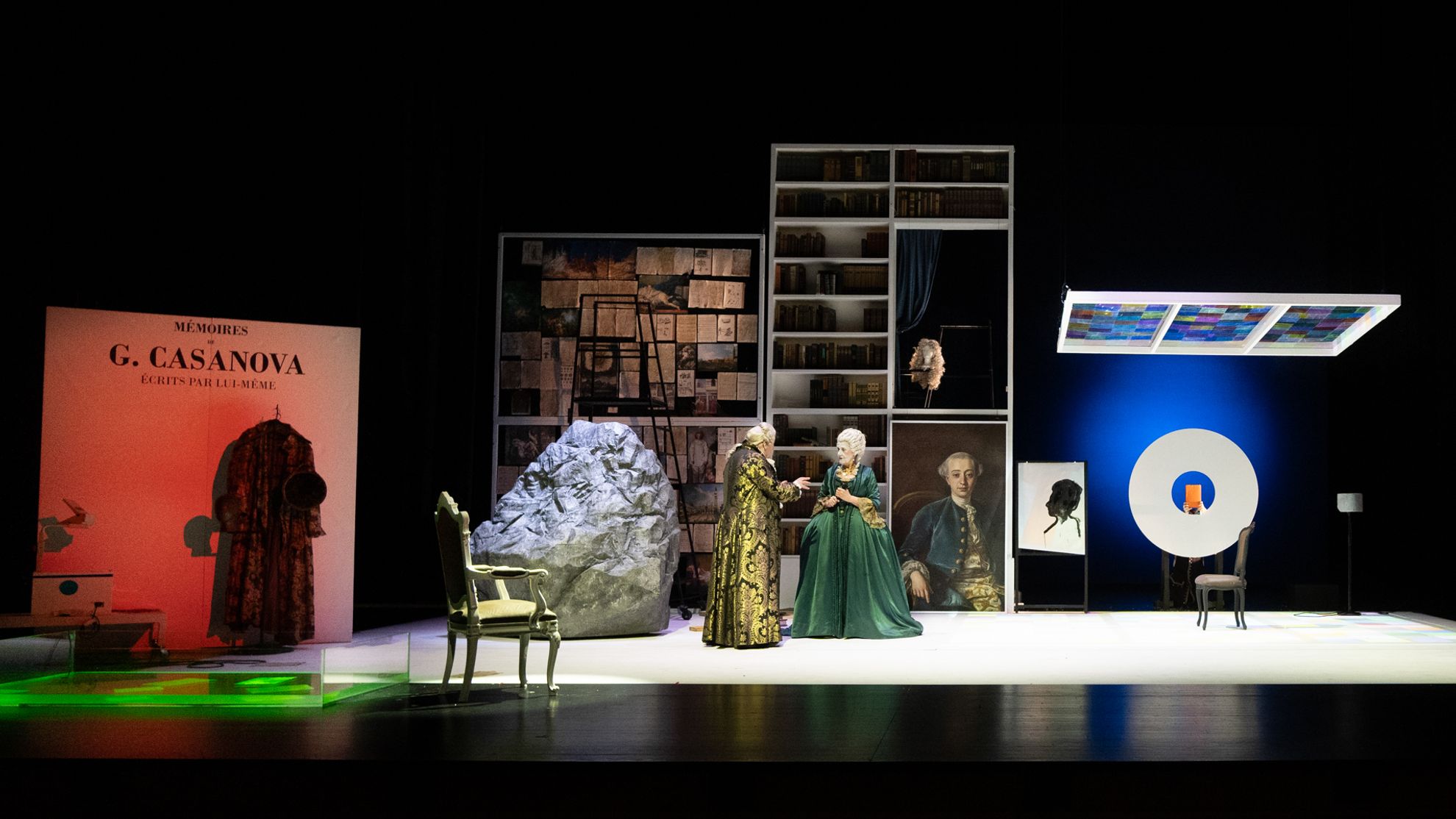
The set design for *Casanova* continues the creative exploration I’ve been pursuing with Fabio Condemi since 2017, which began at the Venice Biennale with Robert Walser’s *Jakob von Gunten *. Since then, we have explored major works, both theatrical and otherwise: Sade’s *Philosophy in the Boudoir* , Thomas Ligotti’s *Nottuari* , Pier Paolo Pasolini’s *Calderón* , and Benjamin Britten’s *The Turn of the Screw *. In all these works—and now in *Casanova* —our approach to the stage has never been monumental, but has always sought a lightness capable of generating ephemeral images that form and dissolve before the audience’s eyes, as in a dream.  
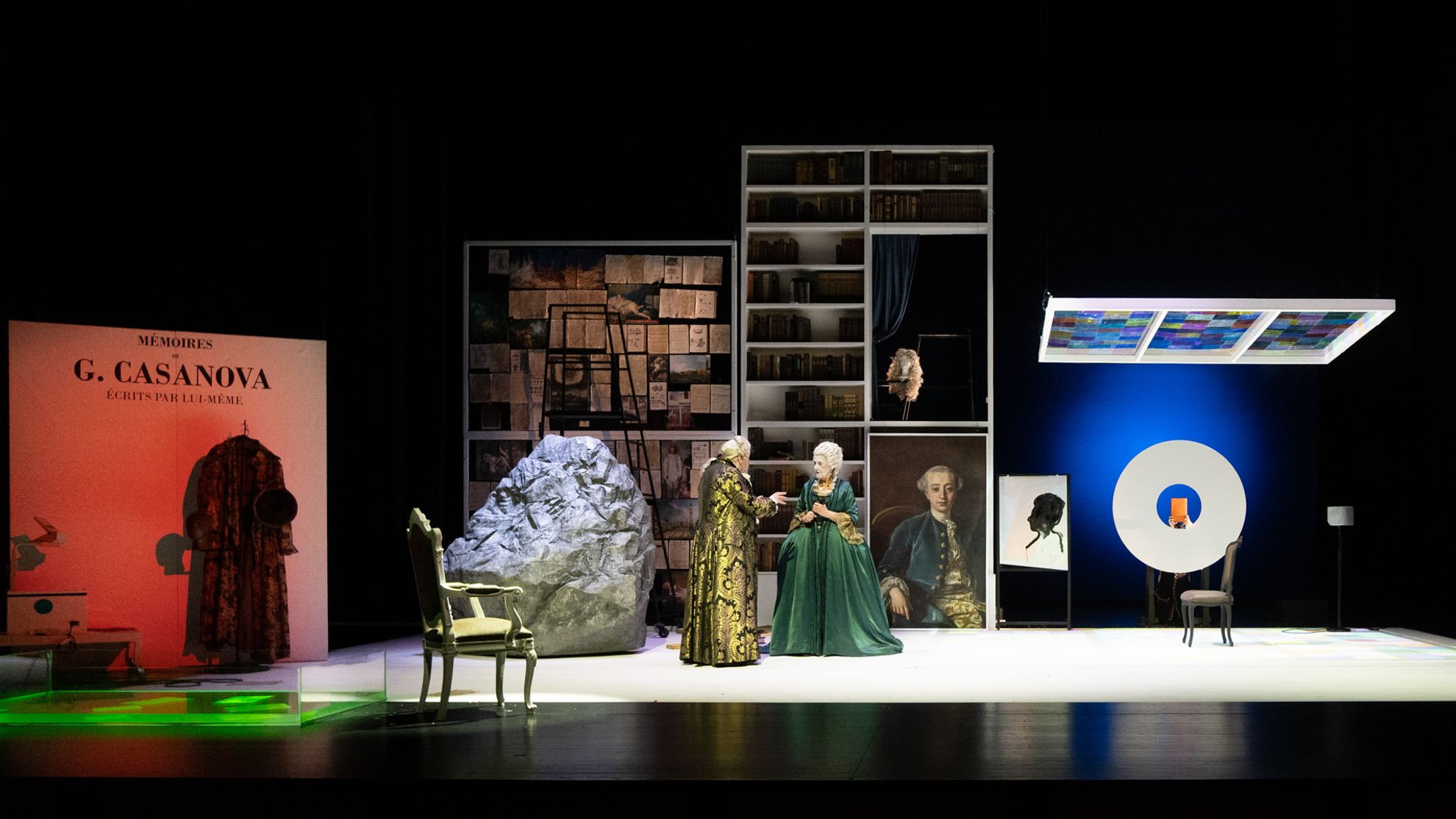
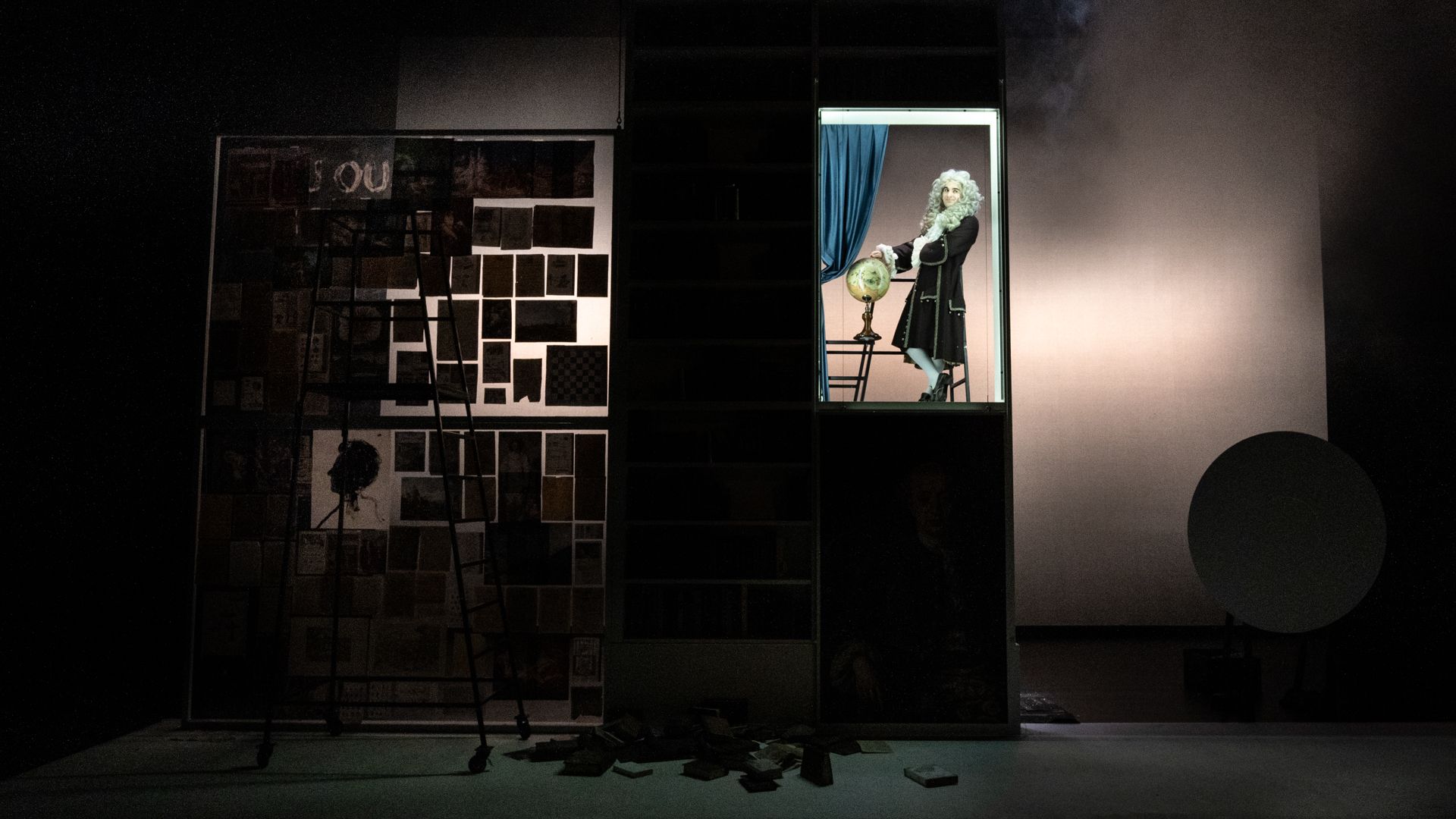
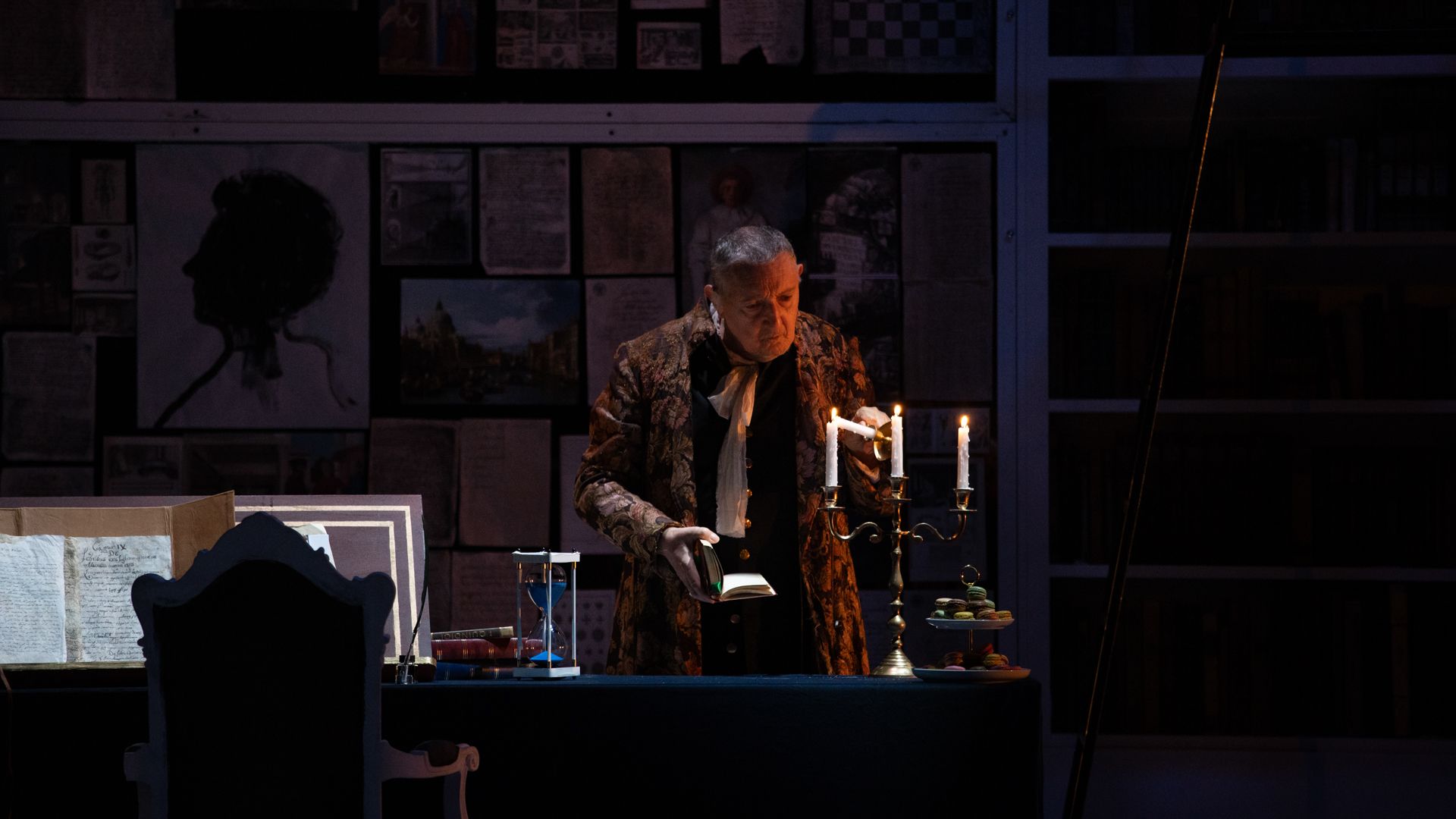
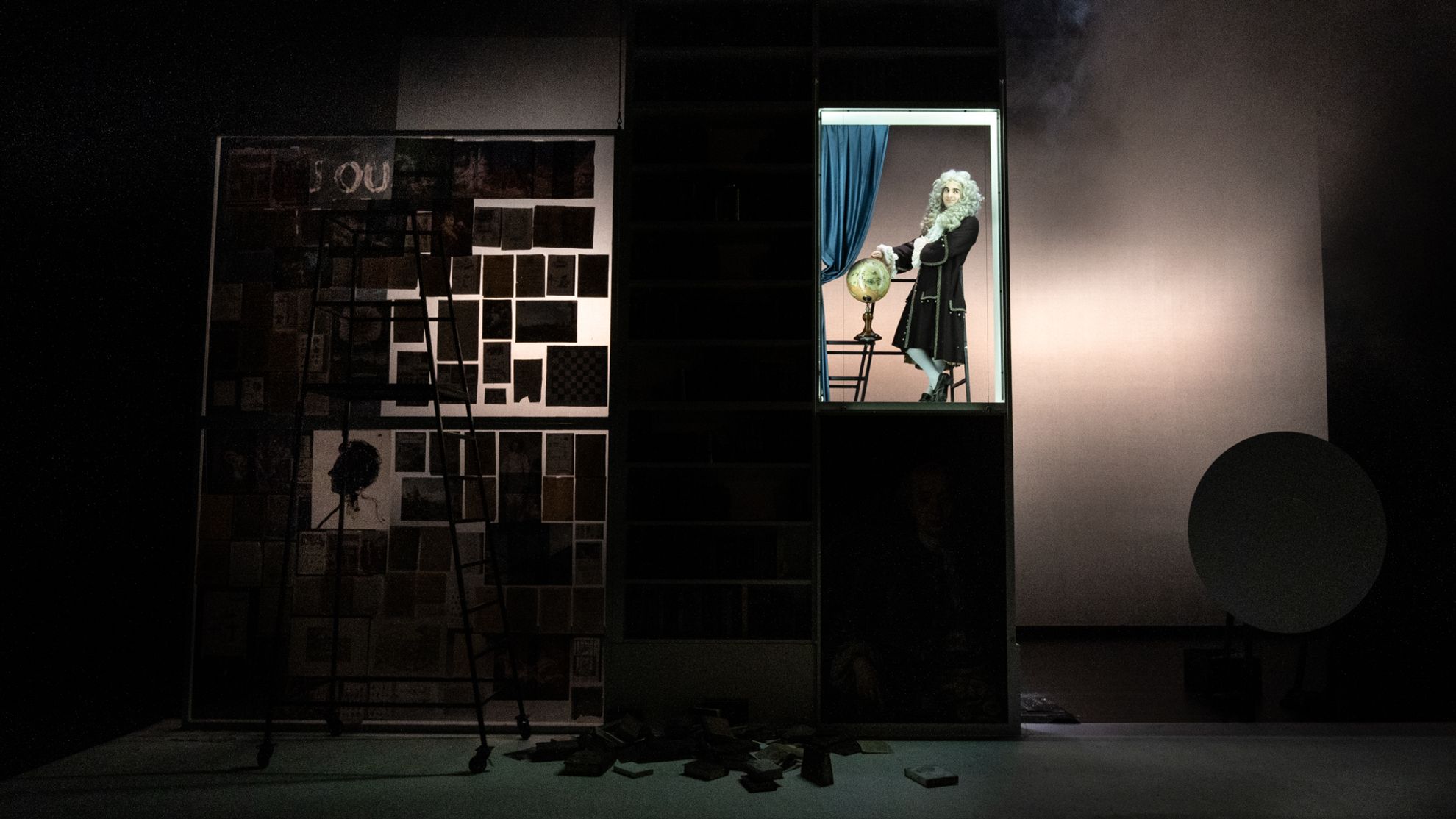
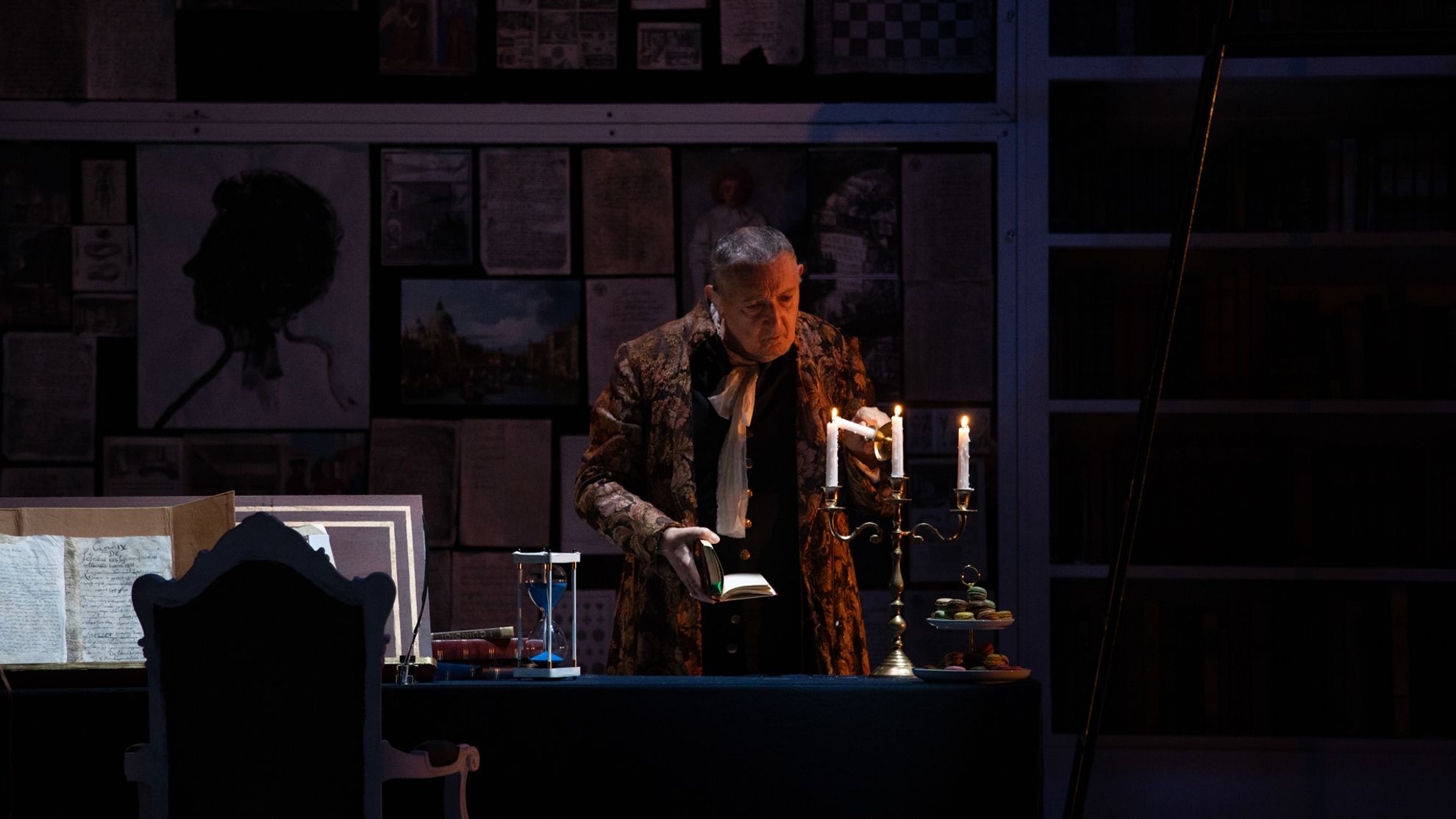
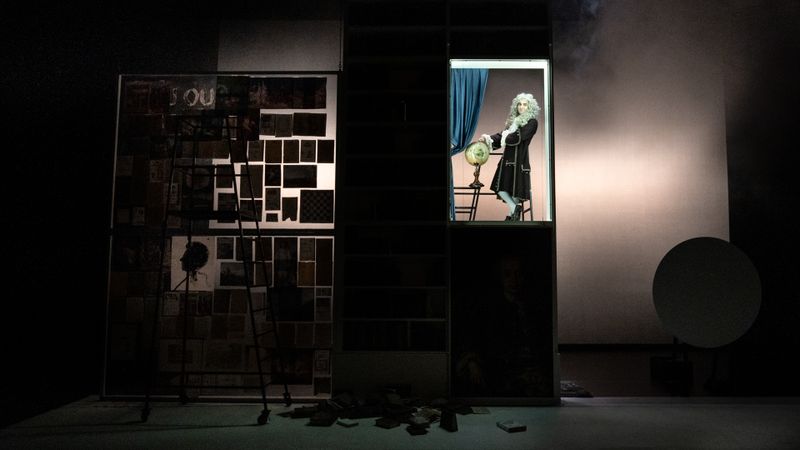
The stage design for *Casanova* explicitly references the library in Dux, Bohemia, where the protagonist, now an old man, writes his memoirs. This is where Fabrizio Sinisi’s dramaturgical vision takes shape: the narrative unfolds through a mesmeric session, transforming memory into a journey through apparitions and fade-outs. The library thus becomes a frame that encloses a shifting content, as in the works of Giulio Paolini, who explored the concept of the frame not only as the boundary of the work but as a gateway to other worlds. In our production, Dux’s library is this perforated frame, which opens onto inner visions and landscapes, evoking the films of Peter Greenaway and Ingmar Bergman—in particular *Wild Strawberries* and *Fanny and Alexander* —in which memory transforms space into a place of the mind. 
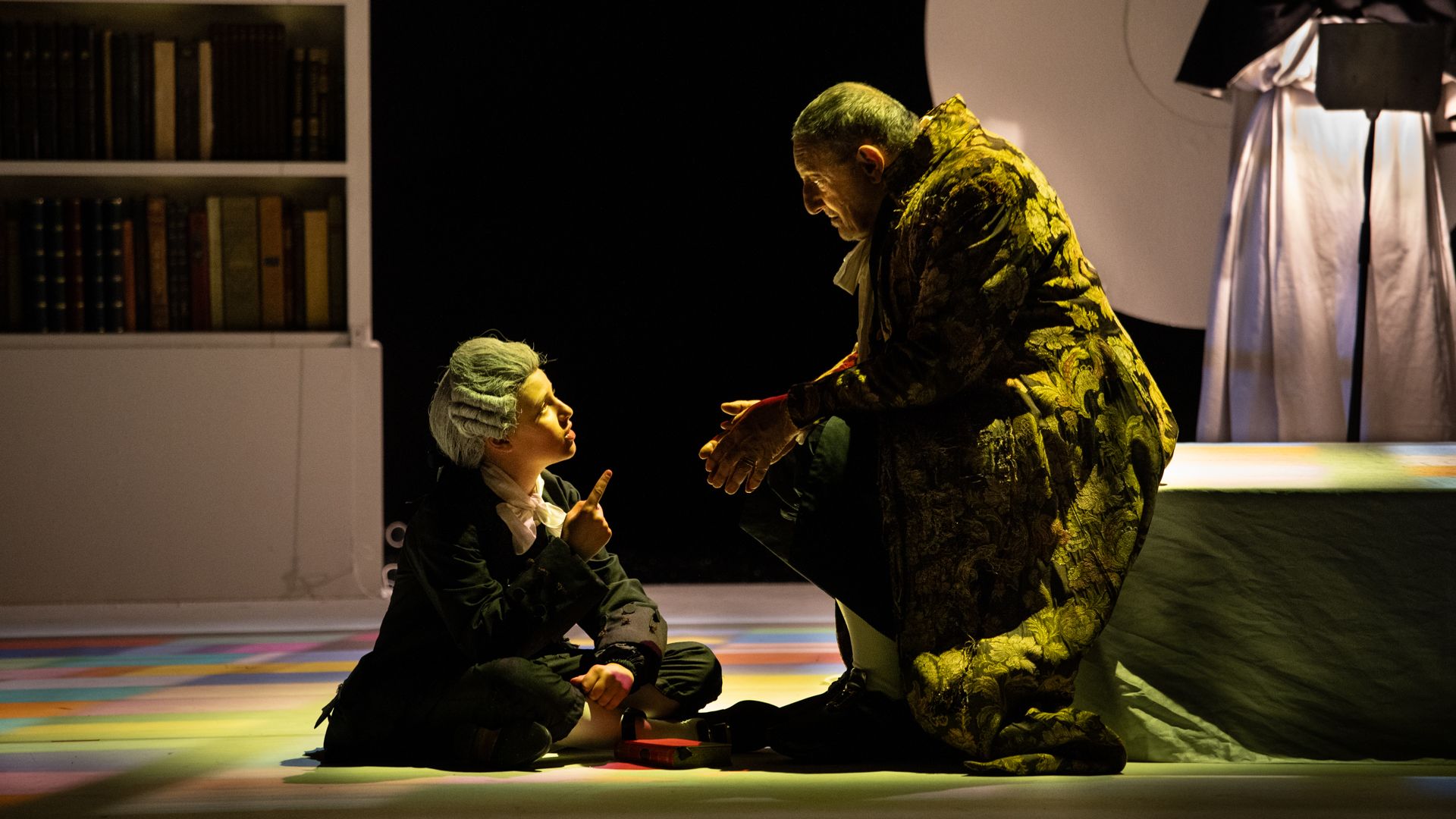
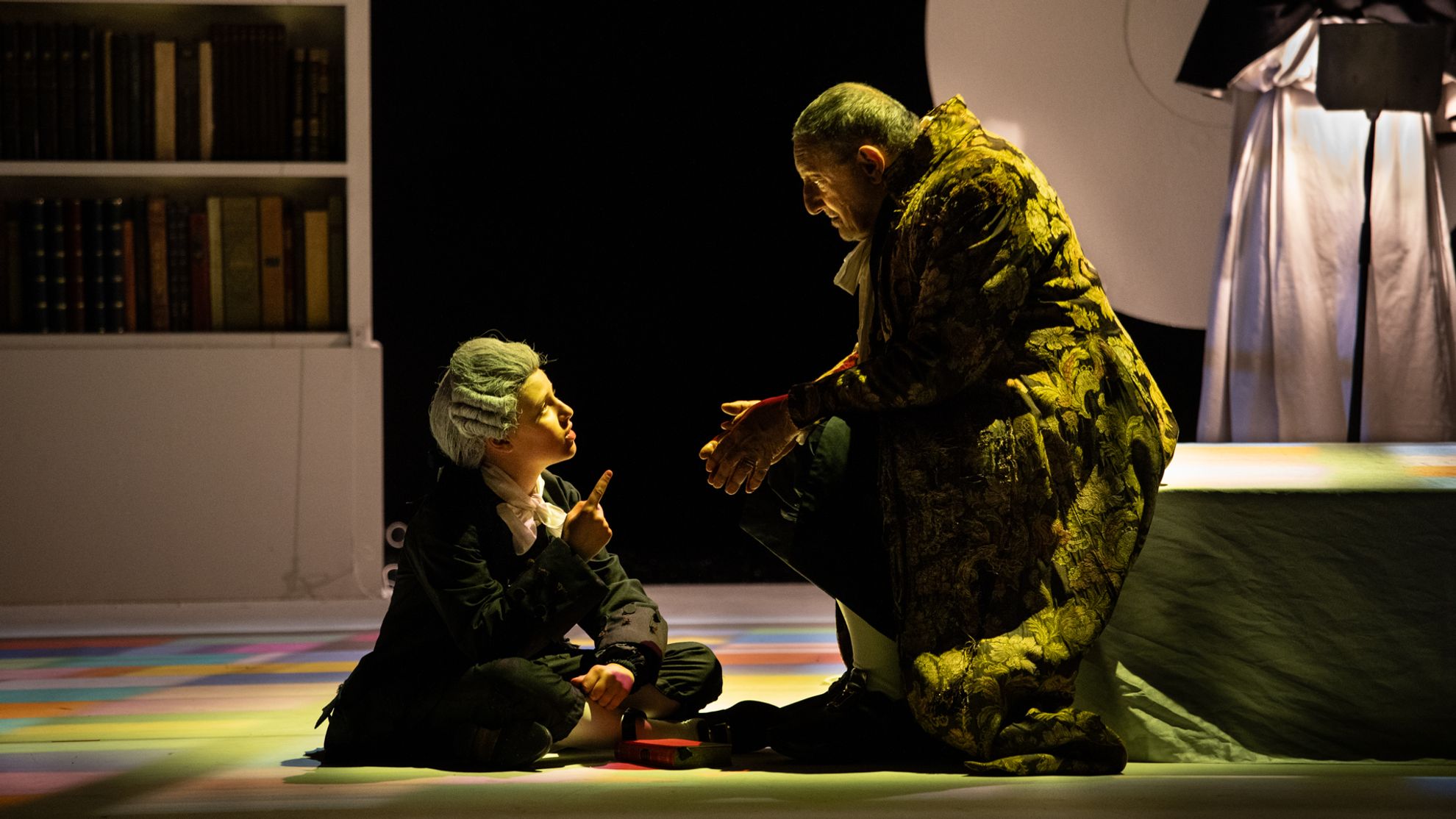
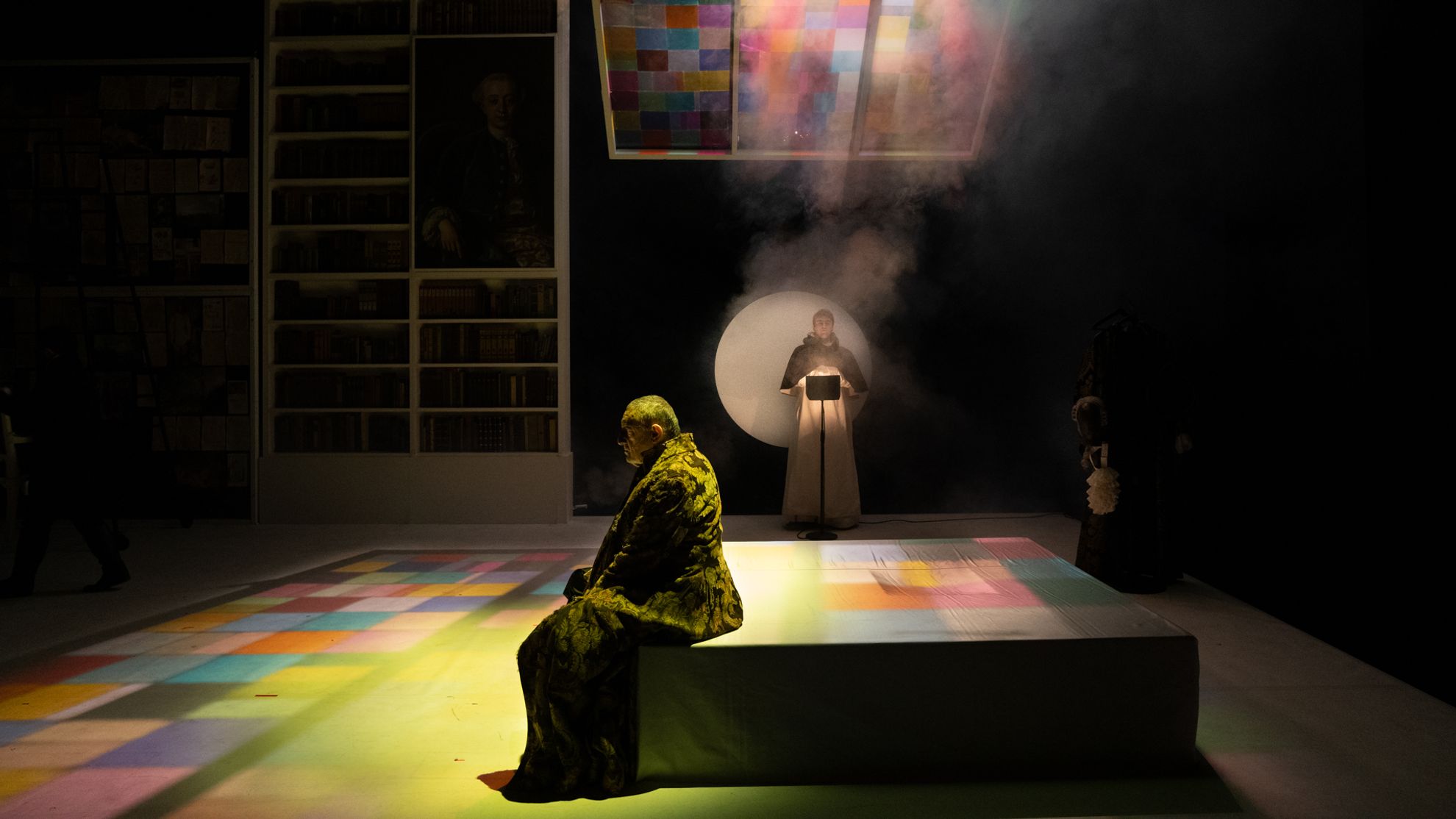
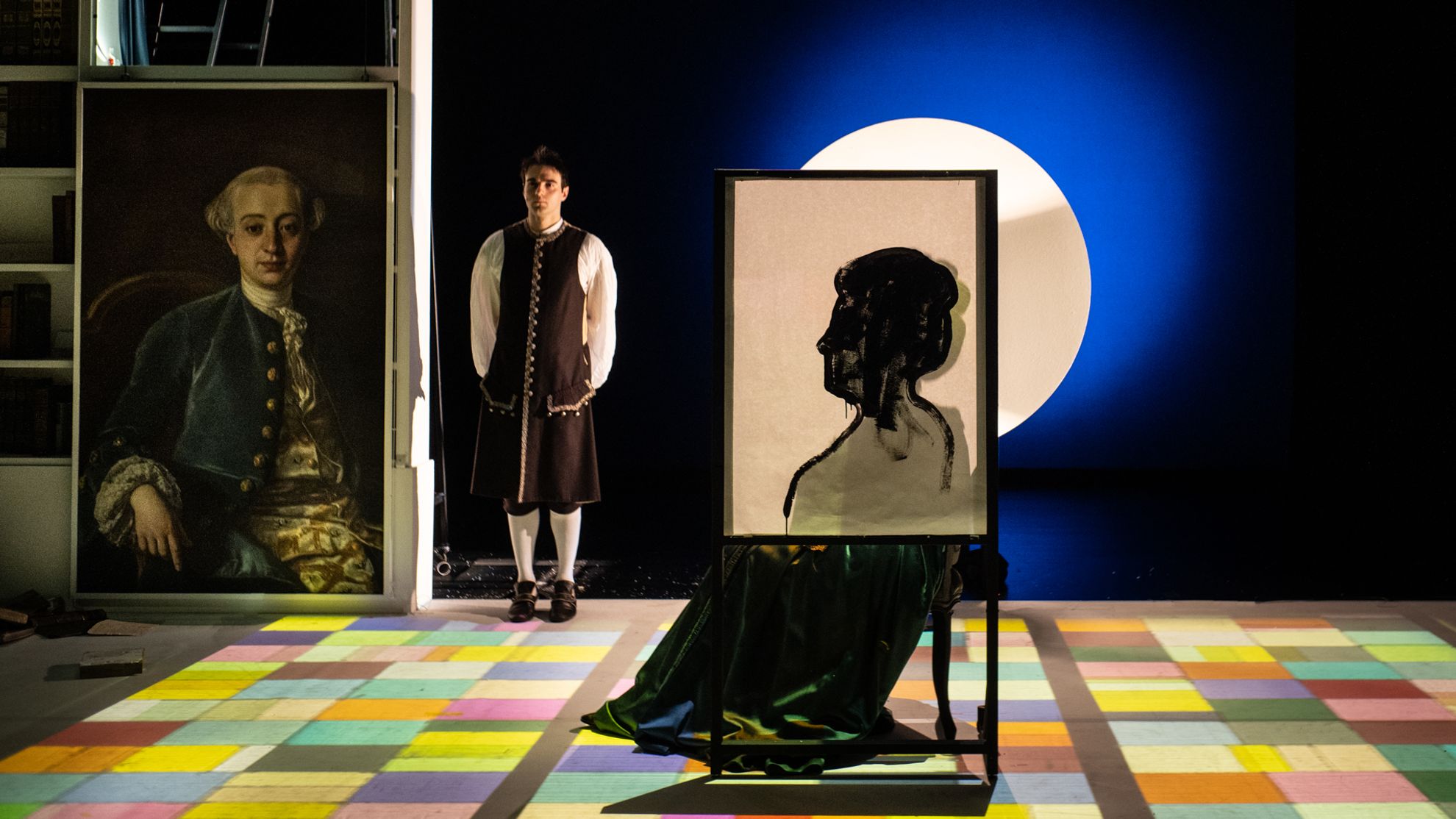
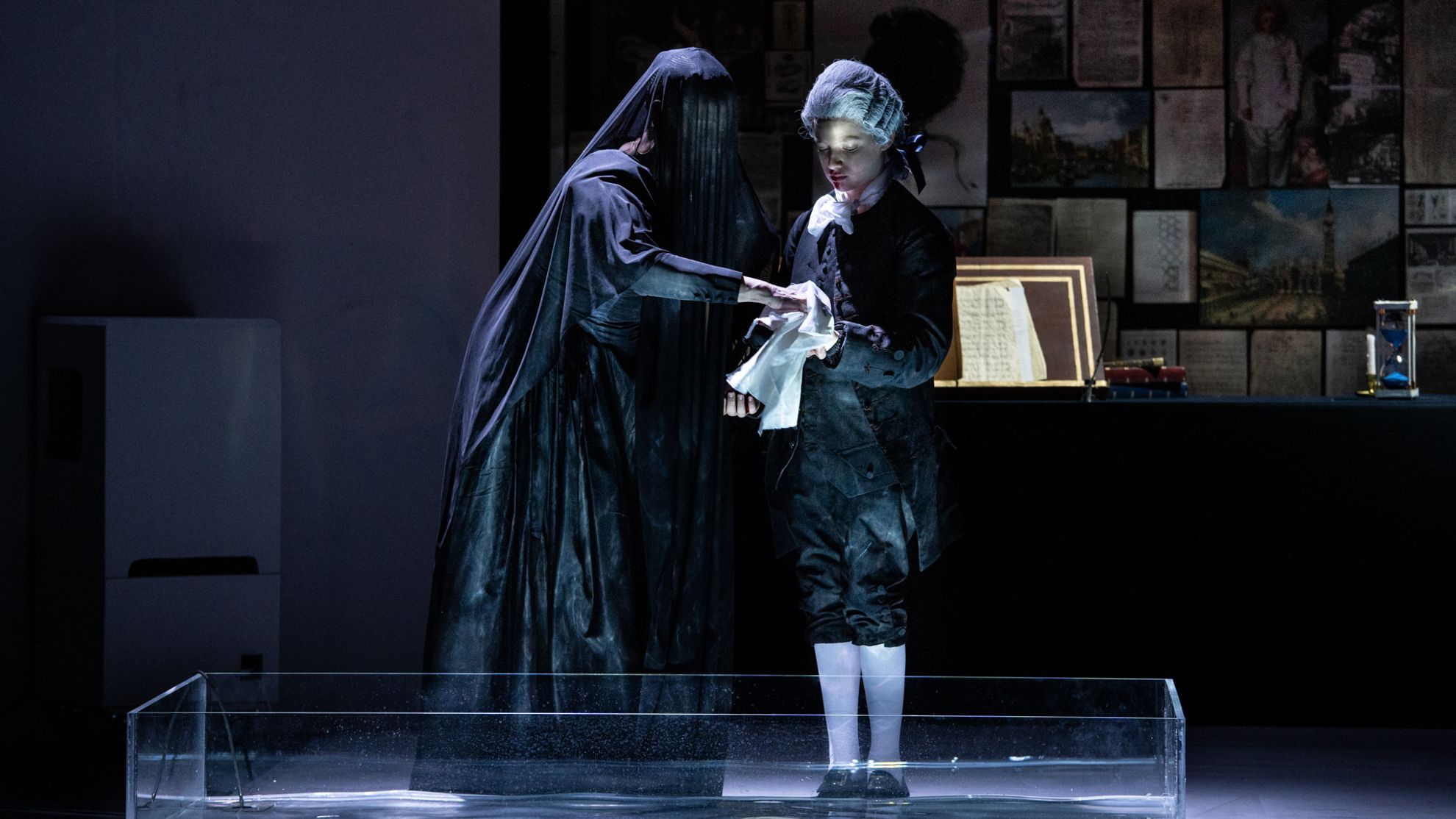
At the center of the scene is a play of overlaps and transparencies. Casanova as a child brings the space to life with a magic lantern, bringing outdoor landscapes into the library, while a large window does not look out onto a forest but onto a lunar rock that evokes the stars and infinite time. Among the bookshelves, a painting depicts a celestial vault—a painted sky that becomes a window onto another space. 
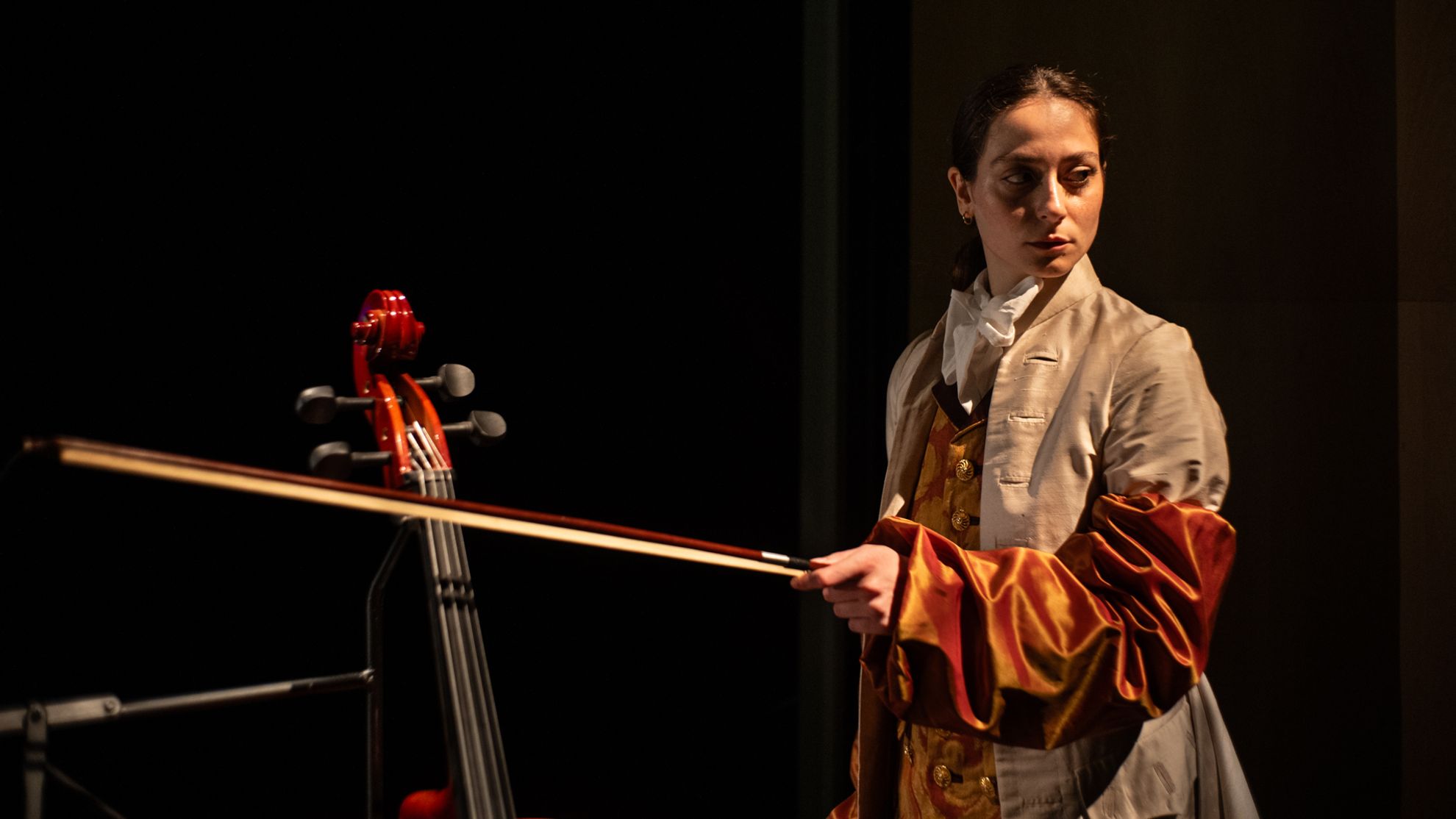
Fundamental to the production is Giulia Pastore’s lighting design, which creates an interplay of light and shadow, allowing us to construct a mental montage of the scenic elements. Like the lighting, Andrea Gianessi’s musical dramaturgy also intervenes in the process of the space’s expansion and contraction. The soundscape projects the exterior into the interior: the sound of the Venetian lagoon blends with that of a mechanical cello, a celibate machine, which—like all the machines of vision present on stage—is designed to open passages, yet without a definitive destination. The convent is evoked by distant choruses; the earthquake by a muffled vibration—an echo of memory. 
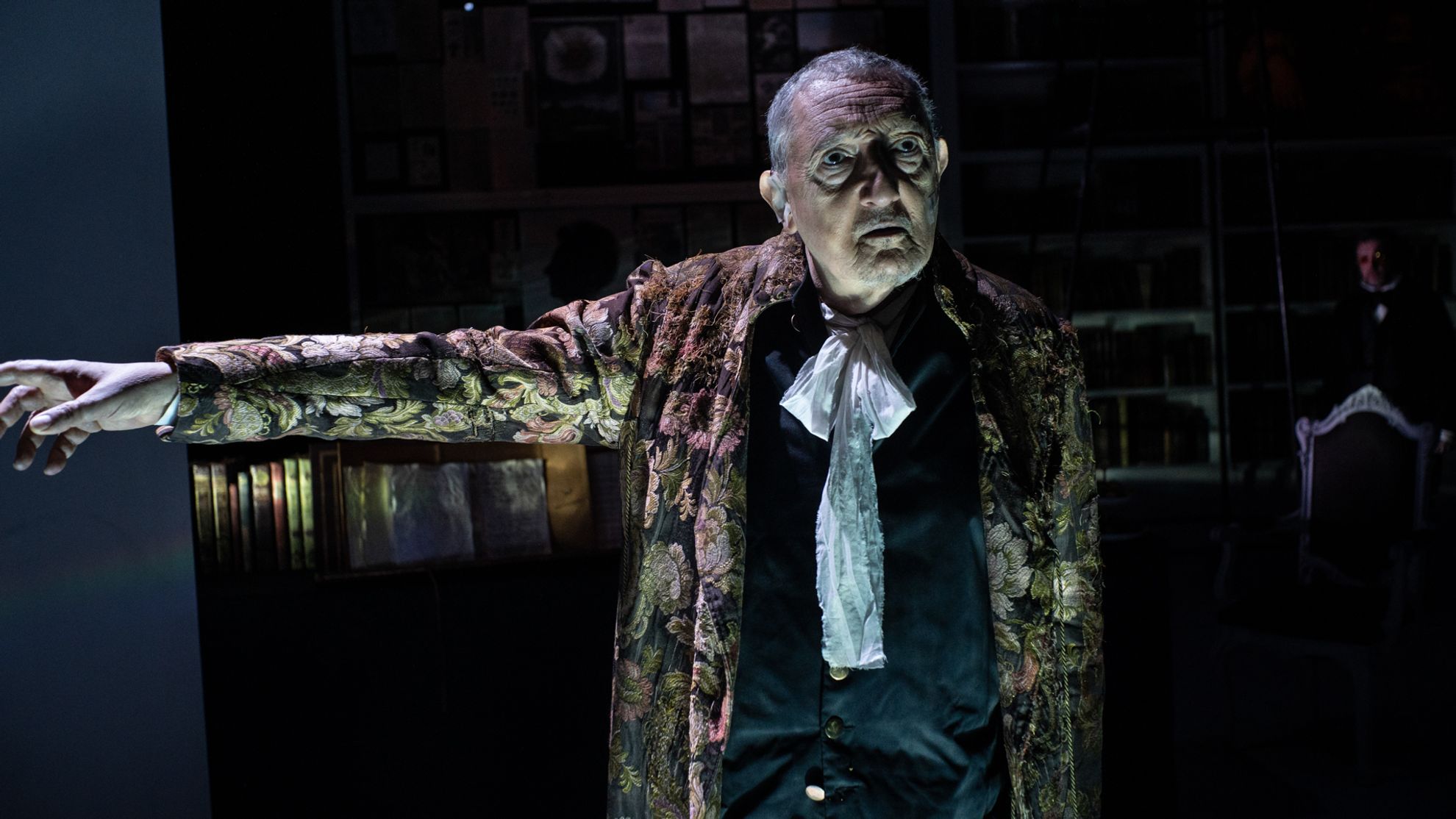
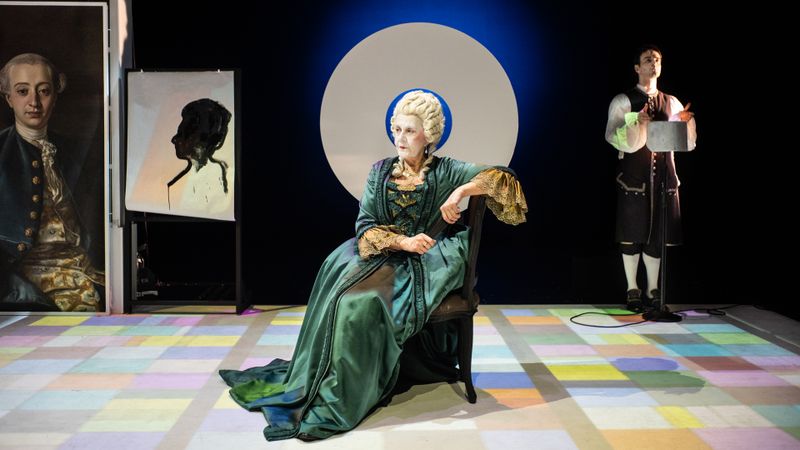
Even Gianluca Sbicca’s costumes contribute to this construction of a non-linear time. The 18th century is referenced in the costumes and certain scenic elements, but it is not faithfully reconstructed: it is a divertissement , a play on contemporary visual imagery. 
Every object on stage is a mechanism of memory. The small hot-air balloon that stands out on the stage—almost like a toy—is transformed in Sandro Lombardi’s performance into a gigantic image, capable of opening up worlds. Like the nosebleed Casanova had as a child—the epistaxis, the first vision from which everything originates—every set element becomes a gateway to memories, a fragment that expands into new visions.

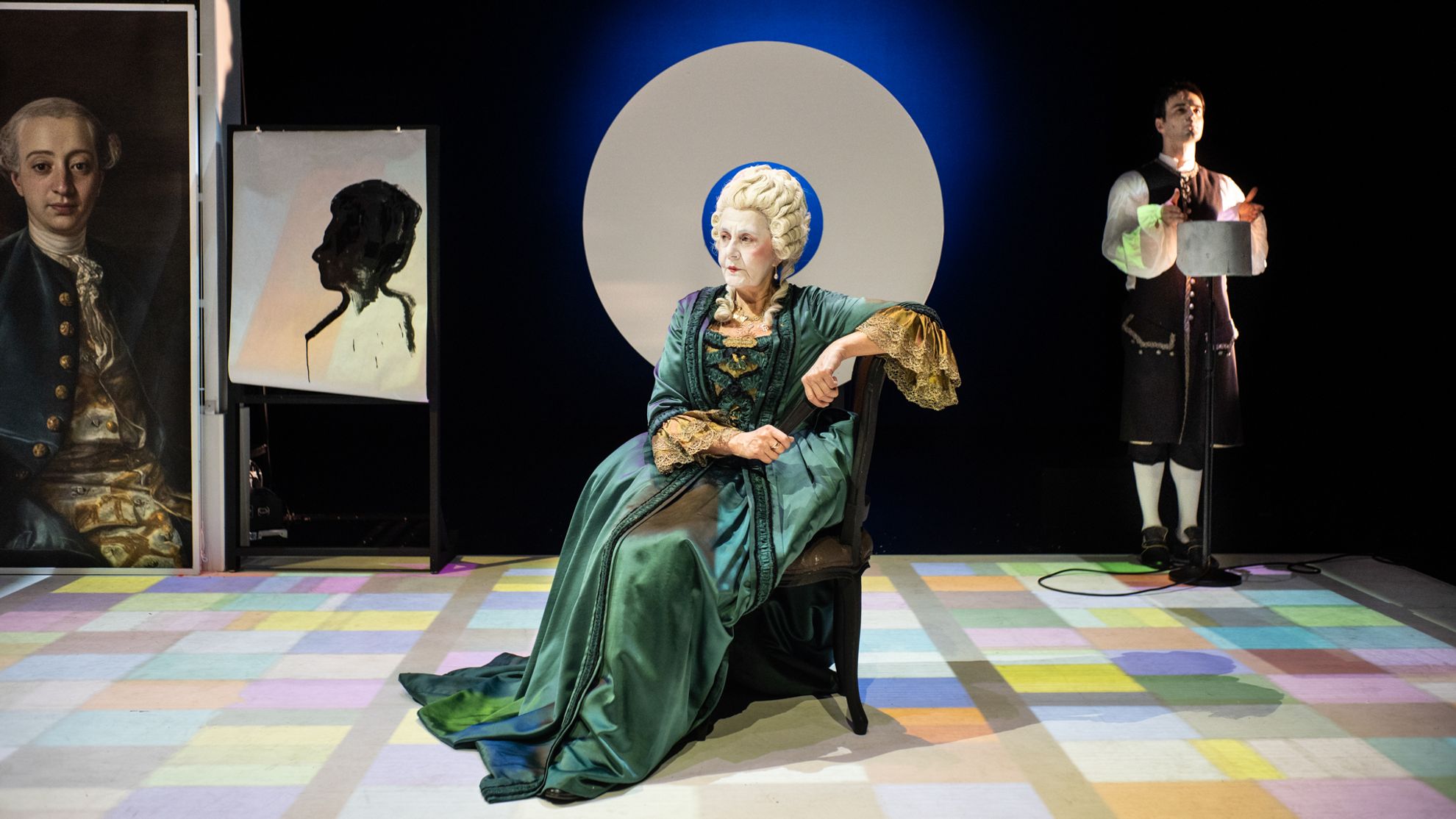
When Fabio Condemi asked me to work on this project, his interest in 18th-century costume—linked to a Venetian aesthetic—was clear from the very beginning: the styles seen in Pietro Longhi’s paintings, Tiepolo’s colors, and the twilight atmospheres typical of the lagoon in winter. To capture this vision, I imagined figures whose silhouettes and colors would be instantly recognizable, offering the audience a clear point of reference and making them easily identifiable. It all began with Casanova’s costume, which provided the key to interpreting all the others, and with Fabio Cherstich’s set design, which—with its installation-based approach to space—called for 18th-century-style costumes, but without the embellishments and ornate details typical of the Rococo style. 
The final effect is to bring to the stage costumes that, in their own way, are “minimalist,” featuring bold colors and, when lit from behind, become silhouettes that immediately evoke the era of Giacomo Casanova. 

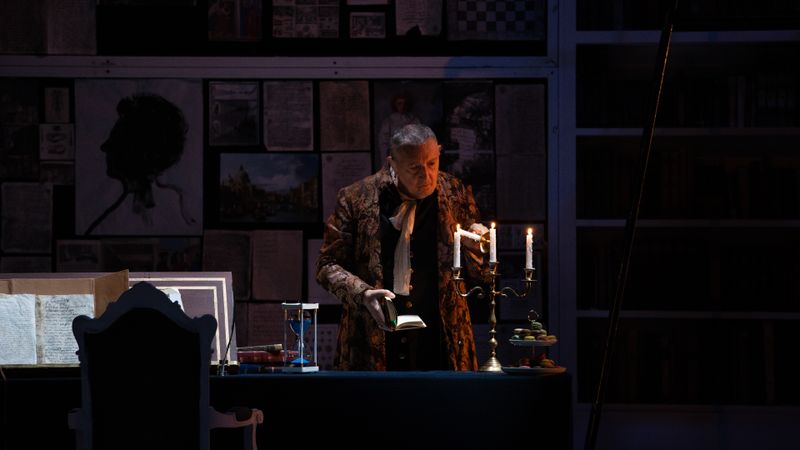
In the Bohemian library where he is confined, Casanova searches by candlelight for the faces of the people he is forgetting, but cannot find them.  
When night falls and he finally manages to plunge into the dream of a mesmeric session, the sound of water carries him to the dark sea of Venice, from which he reemerges into the realm of his memories. Here, as if moved by the lights of a carousel, the figures that appear to him flare up before fading away, seeming nothing more than glimmers of reality—fragments of the past paying a visit to a mind destined for oblivion. 
On stage, Casanova becomes a spectator of elusive images; they dissolve and reassemble into new forms, blending with colors and smoke. As he chases after his mother, who abandoned him on a dark shore, and tries to escape the cone of light from the Piombi prison, he clings tenderly to the reflection of Henriette’s love, while behind him looms the shadow of earthquakes and revolutions.  
But in the space between light and darkness, in the time between sleep and wakefulness, everything dear to us can return, heedless of the passing of time and the changing world.  

The music and sound design I created for *Casanova* delve into the theme of memory gradually fading away—a ghost, a blurred image lost in time, the boundary between an ancient world destined to vanish and a revolutionary future yet to be understood. The cello serves as my dramatic and musical guiding thread—a thread of memory that has never been completely severed; it is the instrument linked to the only woman Casanova may have ever loved, the only one whose face he cannot recall. The soundscape is an electronic transfiguration of 18th-century Venice, with Vivaldi’s music playing in the distance and the lapping of water in the alleys, among the moored boats. The atmosphere is suspended, fluid, as if in a hypnotic session where sounds emerge to embody the people and stories of the protagonist’s life. A swirling acousmatic world in which the cello is, in reality, the pivot and the origin—both in the sound design elements and in the music itself. From Vivaldi’s cello sonatas—deconstructed and recomposed, echoed or transformed into retro-futuristic synthetic sounds—to electronically processed samples drawn from 20th-century experimental cello music, all the way to minimalist techniques such as looping, stretching, and shifting the original musical cells. Every sound inevitably immerses us among the hazy ghosts of memory, in the landscape of Casanova’s ultimate solitude. 

Fabrizio Sinisi
Playwriting
A playwright, poet, and writer, he made his debut as a playwright in 2012 with *La grande passeggiata* , directed by Federico Tiezzi. Since 2010, he has served as dramaturg for the Lombardi-Tiezzi Company and as artistic consultant for the Centro Teatrale Bresciano. His works have been translated and staged in Austria, Croatia, Egypt, France, Germany, Great Britain, Greece, Romania, Spain, Sweden, Switzerland, and the United States. He is a regular contributor to “Doppiozero” and the daily newspaper “Domani.” He has received several awards, including an honorable mention from the American Playwrights Project, the Testori Prize for Literature, and the National Theater Critics’ Award. His first novel is scheduled for release by Mondadori in 2025.

Fabio Condemi ,
Director
Born in 1988, he graduated from the directing program at the “Silvio d’Amico” National Academy of Dramatic Arts in Rome. He subsequently collaborated with Giorgio Barberio Corsetti as an assistant on theater and opera productions, as well as educational projects. In 2018, he made his debut at the Venice Theater Biennale, directed by Antonio Latella, with *Jakob Von Gunten* , adapted from the novel by Robert Walser. The following year, he presented *Questo è il tempo in cui attendo la grazia* at the Teatro India in Rome and the Teatro Verdi in Pordenone—a monologue inspired by Pasolini’s screenplays and performed by Gabriele Portoghese. Since 2019, he has been part of “Oceano Indiano,” the Teatro di Roma’s new production and residency project, alongside DOM, Industria Indipendente, mk, and Muta Imago. In 2020, he presented *La filosofia nel boudoir del Marchese de Sade* at the Venice Theater Biennale, a production for which he won the Ubu Award for Best Direction in 2021. For the LAC Lingua Madre digital project *Capsule per il futuro*, he directed *Analisi Logica* , based on a text by Riccardo Favaro, a work selected for the 2022 Swiss Theater Meeting. In 2022, he staged *Calderón* by Pier Paolo Pasolini as part of the international project “Prospero Extended Theatre.” In 2023, he directed *Nottuari* , based on the works of Thomas Ligotti, and made his opera directing debut with Benjamin Britten’s *The Turn of the Screw* for the Reggio Emilia Theater Company. In 2024, he directed *Ultimi crepuscoli sulla terra* , inspired by the works of Roberto Bolaño.  

Sandro Lombardi
Casanova
Actor, playwright, and writer. Directed by Federico Tiezzi, he has performed in plays by Aristophanes, Beckett, Bernhard, Brecht, D’Annunzio, Luzi, Pasolini, Pirandello, and Schnitzler, among others. His productions of works by Giovanni Testori were particularly significant, revolutionizing the image of the Lombard writer. Four times, between 1988 and 2002, he received the Ubu Award for Best Male Performance. He has recorded on CD Pasolini’s Poems and Dante’s *Inferno* (Garzanti); *The Theater of Giovanni Testori in the Productions of Sandro Lombardi and Federico Tiezzi* (Edizioni ERI); and Giovanni Testori’s *Cleopatràs *. His most recent performances, which have been unanimously acclaimed, include *Antichi Maestri* by Thomas Bernhard (2020), *Scenes from Faust* by Johann W. Goethe, and *Il Purgatorio* by Mario Luzi (2022). In his directorial debut, he directed Anna Della Rosa in *Erodiàs + Mater strangosciàs* (2023). In theater, music, and radio, he has worked with, among others, Furio Bordon, Arturo Cirillo, Giancarlo Cobelli, Rainer W. Fassbinder, Roberto Latini, Claudio Longhi, Mario Martone, Riccardo Muti, Giorgio Pressburger, Carlo Quartucci, Pascal Rambert, Paolo Rosa, Giorgio Sangati, Fabrizio Sinisi, and Fabio Vacchi. He published *Gli anni felici* with Garzanti, a coming-of-age novel that won the Bagutta Debut Novel Prize in 2004. In 2009, his first novel, *Le mani sull’amore* (Feltrinelli), was published, followed in 2015 by *Queste assolate tenebre* (Lindau), which focuses on his work with Mario Luzi.

Marco Cavalcoli Mesmerista
  
He trained at the Teatro delle Albe and then worked in the experimental theater scene of the early 1990s, notably with Teatrino Clandestino, the disco theater company Teddy Bear Company, and finally Fanny & Alexander, of which he has been a member since 1998 and with whom he has appeared in numerous theatrical, musical, and installation productions. Moving between theater, music, audiovisual productions, and radio, he has worked with, among others, Elvira Frosini and Daniele Timpano, lacasadargilla, Nextime Ensemble and Tempo Reale, Mario Perrotta, Giorgina Pi, Mauro Lamanna, Gob Squad, Geppy Gleijeses, Fabio Cherstich, Fabio Condemi, Nerval Teatro, Anagoor, Silvia Rigon, Jacopo Panizza, and Wang Chong, Forced Entertainment and Aldes, Berardo Carboni, Paolo Bonacelli, Veronica Cruciani, Lorenzo Gioielli, Luigi Polimeni, and Dimitri Grechi Espinoza. In film, he has been directed by Sydney Sibilia, the Manetti Bros, Antonio Bigini, and Alessandro Soetje, and as a voice actor by Mitra Farahani and Giovanni Piperno. He reads for the Rai Radio 3 programs *Ad alta voce* and *Cose che succedono la notte *. He teaches at the “Silvio D’Amico” National Academy of Dramatic Arts and at STAP Brancaccio in Rome. In 2022, he won the Ubu Prize for Best Italian Actor. 

Simona De Leo
Henriette
She was born in 2001 in Cinquefrondi, in the province of Reggio Calabria. After earning her high school diploma in the sciences, she attended the “Luca Ronconi” Theater School at the Piccolo Teatro in Milan, where she graduated in June 2024. In December of that same year, she appeared in the play *A Midsummer Night’s Dream (Continuous Commentary) * by William Shakespeare and Riccardo Favaro, directed by Carmelo Rifici.

Alberto Marcello Voltaire
  
Born in 1996, he began his training with actress Lea Karen Gramsdorff, with whom he would go on to have a long-standing collaboration. In 2017, he was admitted to the “Luca Ronconi” Theater School at the Piccolo Teatro in Milan, directed by Carmelo Rifici, where he trained under, among others, Alessio Maria Romano, Francesca della Monica, Antonio Latella, Paolo Rossi, Stefano Massini, Massimo Popolizio, Marta Ciappina, and Lisa Ferlazzo Natoli. He made his debut at the Piccolo Teatro in Milan in *Doppio sogno* , adapted from Arthur Schnitzler’s novella of the same name and directed by Carmelo Rifici, with whom he also worked on *Ci guardano – prontuario di un innocente* as part of the *Lingua Madre* festival. *Capsule per il futuro* , winner of the 2021 Ubu Special Prize. After graduating, she took part in numerous productions, working with various directors, including Giacomo Lilliù in *Teoria della classe disagiata* , Romeo Gasparini in *Il grande nulla *, Chiara Cingolani in *Astra Nostra *, and Federico Tiezzi in *Il Purgatorio*. *La notte lava la mente *, Andrea Chiodi’s *A Midsummer Night’s Dream* and *La Passione *, and Giovanni Ortoleva’s *Twelfth Night (or What You Will) * and *The Lady of the Camellias *. On television, she appeared in the series *Il Mostro* , directed by Stefano Sollima.    

Betti Pedrazzi
Marchesa D’Urfé
A graduate of the “Silvio D’Amico” National Academy of Dramatic Arts in Rome, she began working with Luca Ronconi, her first mentor and director. During those years, she founded the theater company Il Quadro and managed the Teatro Nuovo Eden in Carpi. On stage, she has worked with Luca Ronconi, Giancarlo Cobelli, Vincenzo Salemme, Carlo Cecchi, Valerio Binasco, Toni Servillo, Roberto Andò, and Jean Bellorini, among many others. She won the Borgio Verezzi Award for Best Supporting Actress for her role as Emilia in William Shakespeare’s *Othello* and was nominated for the Ubu Prize for Carlo Goldoni’s *Trilogy of the Vacation *. She was recently directed by Lino Musella in *Pinter Party*.  In film, her most notable recent works include *18 Regali* by Francesco Amato, *Figli* by Mattia Torre and Giuseppe Bonito, *È stata la mano di Dio* by Paolo Sorrentino, *Il più bel secolo della mia vita* by Alessandro Bardani, *Benvenuti in casa Esposito* by Gianluca Ansanelli, *Immaculate*, an international co-production directed by Michael Mohan, and *Iddu* by Fabio Grassadonia and Antonio Piazza, which was in competition at the 2024 Venice Film Festival. On television, he has appeared in several dramas, most recently *Vostro Onore* and *Il metodo Fenoglio* , directed by Alessandro Casale, *Imma Tataranni* by Francesco Amato, and *Antonia*, directed by Chiara Malta.

Edoardo Matteo
Casanova as a child  
Born in 2012 in Milan, he is the eldest of three siblings. Shy and introverted, he has always loved the world of entertainment and cinema, finding in acting a way to embody his favorite characters and fully express himself. In 2019, he moved to Switzerland, where he began to cultivate his passion and attend an acting school. Fabio Condemi’s *Casanova* marked his stage debut.

Fabio Cherstich
Set Design and Dramaturgy of the Image   
Born in 1984, he is a director and set designer for theater and opera. His work combines a meticulous attention to visual aesthetics with a passion for new media and contemporary artistic languages. He has worked at numerous theaters, including the Mariinsky Theater in St. Petersburg, the Teatro Massimo in Palermo, the Teatro dell’Opera in Rome, the Opéra d’Avignon, the Opéra de Marseille, the Théâtre Maillon in Strasbourg, the Teatro Argentina in Rome, and I Teatri in Reggio Emilia. His productions have been invited to prestigious international events, such as the Festival di Napoli, the Festival Première-Strasbourg, the Festival Dei Due Mondi in Spoleto, the STUCK Contemporary Art Center Festival in Leuven, and the Venice Theater Biennale. He is the creator and director of Operacamion , an “opera-on-the-road” project described by The New York Times as “a unique project capable of bringing opera back to its roots.” As a director of performance events in the fields of fashion and design, he has collaborated with brands such as Cassina, Gufram, Memphis Milano, Fay, Hermès, Off-WHITE, and Acne Studio. He teaches the Aesthetics of Theater Direction at the Paolo Grassi Civic Theater School and IULM University in Milan. He has always been interested in contemporary art, with a particular focus on the Manhattan underground scene of the 1980s and 1990s; since 2019, he has served as curator of the Larry Stanton Estate in New York.

Gianluca Sbicca Costume
Design   
Born in 1973, he studied Set Design at the Brera Academy in Milan. After various experiences in the fashion industry, he entered the world of theater as an assistant to Jacques Reynaud on *Lolita*—based on the novel by Vladimir Nabokov (2001), directed by Luca Ronconi—with whom he also collaborated on *Phoenix* by Marina Tsvetaeva (2001). His first production for which he designed the costumes was also directed by Ronconi: *Candelaio* by Giordano Bruno (2001). This marked the beginning of an artistic partnership with Ronconi that lasted 15 years, until his final production, *Lehman Trilogy *. She then began a long-term collaboration with Claudio Longhi, for whom she designed the costumes for several productions, including *La classe operaia va in paradiso* and *Ho paura torero *. Throughout his career, he has also worked—in both theater and opera—with numerous directors, including Massimo Popolizio, Stefano Ricci, Peter Greenaway, Alvis Hermanis, Gabriele Lavia, Federico Tiezzi, Valter Malosti, Giorgio Sangati, Jacopo Gassmann, Sergio Blanco, Roberto Latini, Fabio Condemi, Fabio Cherstich, Lino Guanciale, and Fanny & Alexander. She collaborates regularly with fashion designer Antonio Marras on various installations and theatrical productions. In 2018, she won the Ubu Prize and the Le Maschere del Teatro Italiano Prize for her costumes in Federico Tiezzi’s *Freud or the Interpretation of Dreams* ; in 2022, she received the Ubu Prize for her costumes in Massimo Popolizio’s *M: The Son of the Century *. 

Giulia Pastore Lighting Design
After
completing high school with a classical education and earning a degree in Performing Arts, she specialized in lighting design, working since 2012 with theater and dance companies on Italian and international productions and tours. She has designed lighting for Deflorian/Tagliarini (*La vegetariana*, *Avremo ancora occasione di ballare insieme*, *Chi ha ucciso mio padre*, *Il cielo non è un fondale*, *Memoria di ragazza* ), Carmelo Rifici (*Le relazioni pericolose* ), VicoQuartoMazzini (*La ferocia* ), Cristina Rizzo (*Bolero Effect*, *Ikea*, *Prelude* ), Marco D’Agostin (*Best Regards* , nominated for the 2021 Ubu Awards for Best Dance Performance), Marco Lorenzi (*The Collector* and *Affabulazione* ), Philippe Kratz (*Lydia*, *The Red Shoes*, *Camera Obscura* ), Alessio Maria Romano (*Principia* ), Giorgia Nardin (*Ghisher*, *Anahit* ), Fattoria Vittadini (Amor, Salvaje, To This Purpose Only ), and for all the works by Annamaria Ajmone, for which she is a nominee for the 2022 Ubu Award for Best Lighting Design. From 2018 to 2021, she served as technical and production director for SpazioFattoria, T!nk P!nk, and the Festival del Silenzio in Milan. Since 2022, she has been teaching at the Paolo Grassi Civic Theater School in Milan. In 2024, he won the Ubu Award for Best Lighting Design for the production *La ferocia *.

Andrea Gianessi
Music and Sound Design
Composer, sound designer, musician, and author. A graduate with honors in Music from the DAMS program in Bologna, he is dedicated to exploring the dramatic potential of sound. He is the founder of tsd – Teatro dei Servi Disobbedienti and DAS – Dispositivo Arti Sperimentali in Bologna, where he served as artistic director until December 2024. In 2025, he founded Diade, a performative research group, together with director Federica Amatuccio. He creates music and sound design for the theater, collaborating with artists such as Fabio Condemi, Antonio Latella, Giuseppe Stellato, Franco Visioli (Stabilemobile), Silvia Rigon, Michela Lucenti (Balletto Civile), Fanny & Alexander, Jacopo Squizzato, Menoventi, Mitmacher Teatro, Ateliersi, Andrea Centazzo, and Masque Teatro. His works have been staged at venues such as Emilia Romagna Teatro ERT, Teatro di Roma, Teatro Stabile di Torino, TPE - Teatro Piemonte Europa, LAC Lugano Arte e Cultura, CSS Teatro stabile di innovazione del Friuli-Venezia Giulia, Campania Teatro Festival, Festival delle Colline Torinesi, Kilowatt Sansepolcro, Cantiere Poetico Santarcangelo, Ravenna Festival, OperaEstate, Accademia di Belle Arti di Bologna, and La Biennale Teatro di Venezia. 

Andrea Lucchetta
Assistant Director
Born in 1998, he began his professional career by staging José Saramago’s *Blindness* at the Teatro Nuovo in Naples in 2017. In 2021, he earned his degree in directing from the “Silvio D’Amico” National Academy of Dramatic Arts in Rome. He has directed several of his own productions under the guidance of professionals such as Giorgio Barberio Corsetti in Anton Chekhov’s *On the Main Road *, Massimiliano Civica in a study on Patroni Griffi, and Arturo Cirillo in Eduardo De Filippo’s *These Ghosts *. He works as an assistant to Sergio Ariotti, Andrea De Rosa, Andrea Baracco, Carlo Cecchi, Fabio Condemi, and Leonardo Manzan. He is the founder of the Asilo Republic collective. Among his works are *The Dumb Waiter* by Harold Pinter at the Teatro Nuovo in Naples, a study on Friedrich Dürrenmatt at the Teatro India in Rome, *Electra* by Euripides, *Dust to Dust* by Robert Farquhar, *L’isola di Arturo* by Elsa Morante, and *Il tempo di stare insieme*, for which he served as both playwright and director. In 2022, he staged William Shakespeare’s *The Tempest* , translated by Eduardo De Filippo, at the Teatro Olimpico in Rome. In 2023, the project *Shame Culture*, produced by the Teatro Elfo Puccini in Milan, will premiere.